
The Law, Plainly
Is It Legal to Check SIM Owner Details in Pakistan? The PECA 2016 Answer
Short answer: checking your own SIMs is fully legal. Checking someone else’s is a crime. Every method in our main guide, Check SIM Owner Details Pakistan, works on your own CNIC through official PTA channels, and the law is on your side. But the moment you try to pull a stranger’s name from their number, PECA 2016 Section 16 applies: up to 3 years in prison, a fine up to Rs 5,000,000, or both.
Key takeaways
- Checking your own CNIC’s SIMs is fully legal — the official channels exist for exactly that.
- Section 16, PECA 2016: another person’s identity information = up to 3 years, Rs 5,000,000, or both.
- Section 17 covers unauthorised SIM issuance: up to 3 years, Rs 500,000.
- 667 and 76367 stay legal by design: possession-based and network-only.
- Victim of misuse? NCCIA 1799 or complaint.nccia.gov.pk.
So is it legal to check SIM owner details? Under PECA 2016, it depends on one word: whose. This page quotes the actual law, prints the correct penalty table (most sites get it wrong), and shows exactly where the legal line sits. Two minutes here and you’ll never have to guess.
On this page
The one-line rule
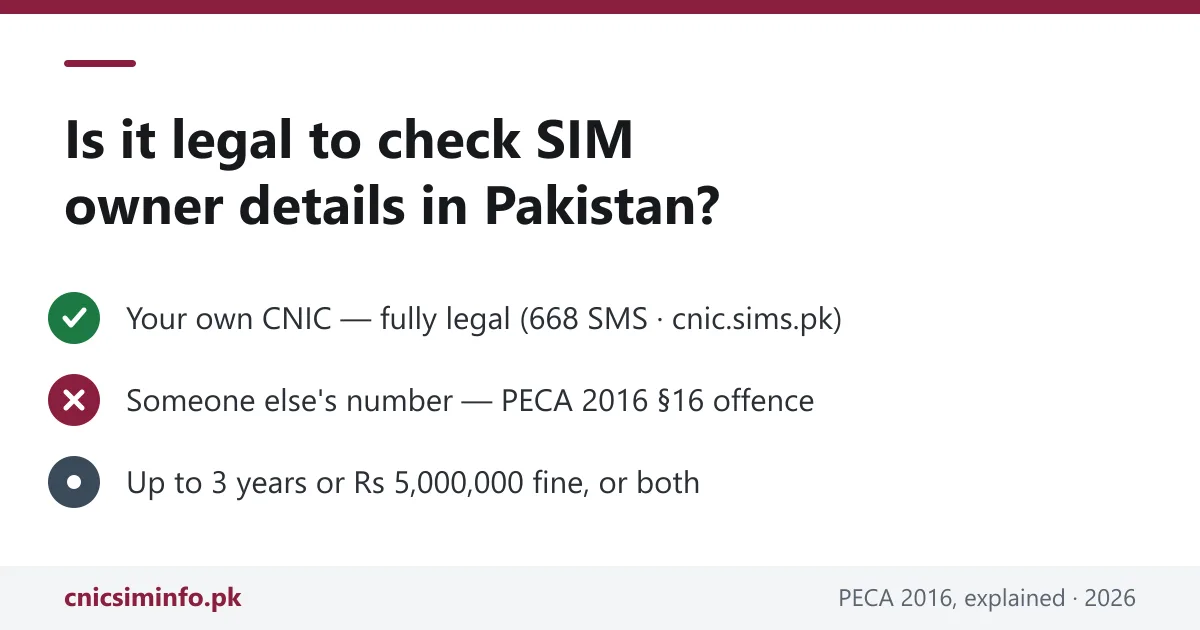
You are authorized for your own identity. That’s the whole test. Your CNIC, your SIMs, your record: every official check is built for exactly this, and using them is what PTA wants you to do.
Nobody is authorized for a stranger’s identity. Not through an app, not through a website, not through a “database”, not through a helpline trick. Pakistani law calls another person’s name, CNIC number and phone number their identity information, and reaching for it without authorization is the offence itself.
That single sentence separates every legal method from every illegal one. Keep it in your pocket and the rest of PECA 2016 is just detail.
What PECA 2016 Section 16 actually says
PECA 2016, the Prevention of Electronic Crimes Act, is the law that governs this space. Section 16 covers unauthorized use of identity information, and its wording is worth reading once in full:
“Whoever obtains, sells, possesses, transmits or uses another person’s identity information without authorization shall be punished with imprisonment for a term which may extend to three years or with fine which may extend to five million rupees, or with both.” Prevention of Electronic Crimes Act 2016, Section 16
Read the verbs again: obtains, possesses, uses. The section doesn’t only catch the people selling data. The person who looks it up is inside the wording too. Paying a WhatsApp seller Rs 500 for a “premium check” or downloading a lookup APK puts you in the same sentence as the seller.
Section 17 covers the other direction: SIMs issued in your name without your consent. Selling or issuing a SIM without proper verification carries up to 3 years, a fine up to Rs 500,000, or both, on PTA’s written complaint. If a franchise agent activated a SIM on your fingerprints without telling you, that’s the section that protects you.
The corrected penalty table
Copies of this table across the internet are wrong: invented “7 years”, stitched fines, sections that don’t exist. Here is the accurate PECA 2016 table, straight from the Act:
| Section | Offence | Maximum penalty |
|---|---|---|
| Section 16 | Unauthorized use of identity information (names, CNICs, numbers) | 3 years / Rs 5,000,000 / both |
| Section 17 | Unauthorized issuance of SIM cards | 3 years / Rs 500,000 / both |
| Section 3 | Unauthorized access to an information system or data | 3 months / Rs 50,000 / both |
| Section 4 | Unauthorized copying or transmission of data | 6 months / Rs 100,000 / both |
Two things to notice. Section 3’s fine is Rs 50,000, not the Rs 100,000 many pages print. And there is no combination that produces “7 years and Rs 5.7 million”; that figure is stitched together from unrelated sections and appears in no statute. We pulled apart that whole family of invented PECA 2016 penalties on our SIM myths fact-check page.
What you can legally do (all of it, free or nearly free)
- Count your SIMs: SMS your 13-digit CNIC (no dashes) to 668 (about Rs 2 including tax), or use cnic.sims.pk free from anywhere in the world. NICOP and POC work too.
- Verify the SIM in your hand: send “MNP” to 667. It confirms the number’s registration against a masked CNIC. It never reveals a stranger’s identity.
- Find a number’s network: send “N 03XXXXXXXXX” to 76367. You get the current network only, never a name.
- Check your biometric status: Jazz CNIC to 6001, Telenor CNIC to 7751, Zong V to 7911, Ufone *336*1#.
- See your own number: Jazz *99#, Zong *8#, Telenor *8888#, Ufone *780*3#.
- Ask PTA directly: helpline 0800-55055, or the PTA Digital Assistant on WhatsApp at 0315-0055055 (launched 25 February 2026).
- Remove a SIM from your name: visit any franchise of that operator with your original CNIC and say “SIM Disowning”. Fee is up to Rs 200, waived in fraud cases.
- Report a crime: NCCIA cybercrime helpline 1799 (formerly FIA’s 1991) or complaint.nccia.gov.pk.
Notice the pattern: every legal method starts with your own CNIC or your own handset. That’s the authorization Section 16 talks about, and it’s why these routes are safe while everything in the next list isn’t.
What to stay away from
- “SIM database” websites and “pak sim data” pages. SVMS, the registry behind every real check, has no public API for anyone. These sites recycle old breach data or simply fabricate results, and using them sits inside PECA 2016 Section 16’s wording.
- Lookup apps and APK downloads. Their own listings admit the data is “publicly available” or “user-submitted”. Reviews are full of payment scams.
- WhatsApp “premium data” sellers. Selling identity data is a Section 16 offence. Buying it is the same section.
- “Live tracker” services. Location data needs a court-sanctioned legal process. Any public “tracker” is fake, a scam, or both.
The state actively hunts this market: 83 illegal SIM-sale websites were blocked in one year (Jul 2024 to Jun 2025), 1,372 personal-data sites and apps were reported blocked by September 2025, and an NCCIA-led probe uncovered and blocked 139 data-selling platforms by October 2025. These services vanish, but the risk they leave behind lands on the person who used them.
The law-enforcement boundary
One honest question deserves an honest answer: can anyone check a stranger’s SIM details? Yes, two groups can. Investigators inside a registered case, armed with a written legal demand — and courts, through orders in their own proceedings. The operator or PTA provides the record to them, under a written trail.
That’s the entire list. There’s no public version of that door, no “agency contact” selling access, and no app that inherited it. Anyone claiming otherwise is describing a PECA 2016 offence, not a service. If a genuine legal need exists (harassment, fraud, a case), the route is a complaint to NCCIA at 1799 or your local police, who can lawfully obtain what you never could.
If someone used YOUR identity
The law also works for you. If 668 or the portal shows a SIM you never bought, do three things in order. First, screenshot the result with its date. Second, visit that operator’s franchise with your original CNIC and say “SIM Disowning”; keep the written reference number. Third, if you suspect fraud rather than a paperwork mistake, file with the NCCIA at 1799 or complaint.nccia.gov.pk the same day; Section 17 exists exactly for this.
One timing note: since PTA’s 24 May 2026 advisory, a newly activated SIM can’t be disowned or transferred for 365 days from its activation date, so unknown SIMs are worth catching early. Rule changes like that one are archived, dated and sourced, in our PTA SIM news changelog.
Frequently asked questions
Is it legal to check how many SIMs are on my CNIC?
Yes, completely. 668 and cnic.sims.pk are official PTA services built for exactly this. Checking your own record monthly is what the regulator recommends.
Is it legal to check SIM owner details of another number?
No. Another person’s name, CNIC and number are identity information under PECA 2016 Section 16. Obtaining or using them without authorization carries up to 3 years, a Rs 5 million fine, or both.
Can I legally get a name and address from a phone number?
No legal public service exists for this, anywhere in Pakistan. SVMS has no public API. Sites promising it are recycling breach data or faking results, and using them is itself a Section 16 act. The full reframe: SIM owner details by number.
What’s the punishment for using SIM owner details apps?
PECA 2016 Section 16 reaches whoever “obtains, possesses or uses” identity information without authorization: up to 3 years in prison, up to Rs 5,000,000, or both. The user, not just the seller.
Are 667 and 76367 legal to use on any number?
They’re legal because they reveal no identity. 667 verifies the SIM physically in your hand before porting. 76367 returns only the current network of a number (“N 03XXXXXXXXX” format). Neither shows a name or CNIC.
Can police or agencies check any SIM’s owner?
Yes, through a documented legal request tied to a case, or a court order. That channel never passes through public apps or websites, and nobody can sell you access to it.
Is it illegal to have more than 8 SIMs?
The cap (5 voice + 3 data, set by the Supreme Court on 5 November 2015) is enforced at activation, so a 9th SIM shouldn’t activate at all. Older extras on your CNIC won’t jail you, but they’re your liability; disown the ones you don’t use.
Someone issued a SIM on my CNIC. Which law protects me?
PECA 2016 Section 17 (unauthorized SIM issuance): up to 3 years or Rs 500,000 on PTA’s written complaint. Disown the SIM at the franchise, then report to NCCIA at 1799 or complaint.nccia.gov.pk.
Roman Urdu mein
Apna CNIC-record dekhna poori tarah jaiz hai: 13-hindsa CNIC (dash ke baghair) 668 par SMS karein (about Rs 2) ya cnic.sims.pk kholein (free). Lekin kisi aur ke number se uska naam ya CNIC nikalna PECA 2016 Section 16 ke under jurm hai: 3 saal tak qaid, Rs 50 lakh tak jurmana, ya dono. Agar aap par koi anjaan SIM nikle to franchise par “SIM Disowning” kahein aur 1799 par report karein.

Written and reviewed by Muhammad Hamza, founder and editor of CnicSimInfo. Sources: the PECA 2016 statute text, PTA’s SIM Information pages, the Supreme Court order of 5 November 2015 (via Express Tribune), NCCIA notices, and PTA’s 24 May 2026 advisory (confirmed to Geo Fact Check). Re-verified quarterly; this is general information, not legal advice. Last reviewed: 6 July 2026. See our Editorial Standards and the SIM verification glossary.