
Method Deep-Dive · The SIM in Your Hand
667 SIM Check (MNP): Verify Any SIM in Your Hand, the Right Way
The 667 SIM check answers one question no other code touches: is the SIM physically in your hand properly registered, and to whom? Send the word MNP from that SIM to 667 at standard SMS rate, and the reply confirms its registration status against a masked identity. Its sibling 668 counts your whole CNIC instead; this page masters both halves of that pair. The complete self-check toolkit lives at Check SIM Owner Details Pakistan.
Key takeaways
- Send MNP to 667 from the SIM being checked; the reply confirms registration status against a masked identity.
- 667 answers for one physical card; 668 counts every SIM on your CNIC. A full audit uses both.
- It cannot be aimed at a stranger’s number, because the SMS must leave the SIM itself.
- Run 667 before porting, after buying a used device, and on every drawer SIM you rediscover.
- Cost: your operator’s standard SMS rate. Works on Jazz, Zong, Telenor, Ufone and ONIC alike.
One line before the detail. A 667 sim check verifies your own card, and 668 audits your own record. Neither exposes anyone else’s sim owner details, and hunting a stranger’s identity by any route is an offence under Section 16, mapped on our legality page. Everything below is the self-check version, which is the only version that exists legally.
On this page
What the 667 SIM check is
667 is Pakistan’s SIM-verification short code, run inside the Mobile Number Portability framework and answering on every major network. Where most codes talk about accounts or balances, 667 talks about identity. It tells you whether the card that sent the message is properly registered in PTA’s Subscriber Verification Management System, the registry behind every legal check on this site.
The design has one property worth admiring. Because the query must travel from the SIM being checked, the code carries its own consent mechanism; possession is the password. Nobody in Lahore can run a 667 sim check on your Karachi number, and you cannot run one on theirs. Compare that with the fake “databases” our Pak SIM Data investigation documents, which pretend consent does not exist and end up on the wrong side of the law.
That is also why 667 belongs in your pocket rather than your bookmarks. It travels with the SIM, works on a ten-year-old handset, and needs no internet, which in half of Pakistan is the difference between a check you run and a check you postpone.
Running it: the 30-second routine
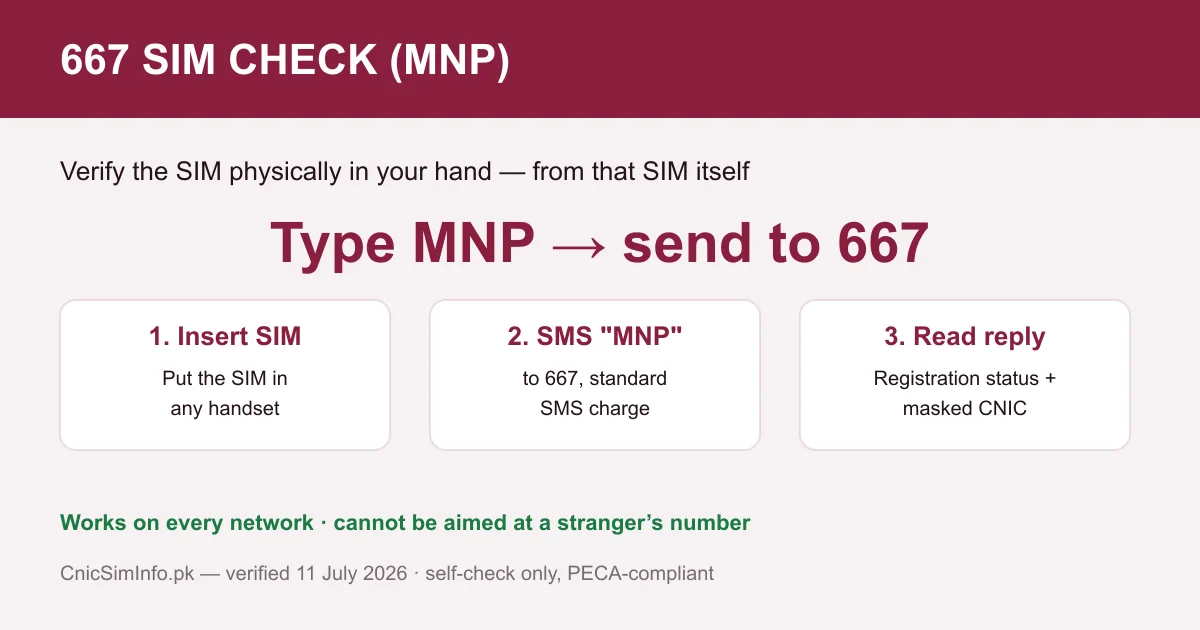
- Seat the SIM in any working handset and give it a moment to catch signal. The phone’s brand is irrelevant; the card is what answers.
- Type the single word MNP in a new SMS. No CNIC, no number, no punctuation, nothing else.
- Send it to 667. Your operator’s standard SMS charge applies, usually a rupee or two.
- Read the reply that lands within a minute or so: the SIM’s registration status, confirmed against a masked identity.
- Screenshot it with the date. If the card later goes to a franchise for porting or correction, that screenshot is your before picture.
The routine never changes across networks, which makes it the rare Pakistani telecom instruction you can memorise once and reuse forever.
Reading the reply, line by line
By design the reply is short, and each element earns its place. Expect the essentials: confirmation that the SIM is registered, and identity digits shown in masked form so the message stays safe even if your phone is in someone else’s hands later.
Read it against one question: does this match me? Masked digits that align with your own CNIC mean the card is yours on paper as well as in pocket. A registered status against digits that cannot be yours means the card belongs to someone else’s record, and the honest next step is a franchise counter, not continued use. An unregistered or failed status means the card should not be in service at all.
What the reply never contains matters just as much: no full CNIC, no owner name for strangers, no address. The masking is the same privacy-by-design that runs through 668 and cnic.sims.pk, described across our twelve official methods. Treat any service that promises fuller sim owner details from a bare number as the scam it is; our by-number reality check explains why that door does not exist.
The sibling code: 668 in one minute
668 is the census taker. SMS your 13-digit CNIC, no dashes, to 668 for about Rs 2 with tax, and PTA’s registry replies with your SIM count on every network at once. Jazz, Zong, Telenor, Ufone, SCOM: one message, one scoreboard.
Its blind spot is the mirror of its power. 668 counts records, not cards, so it can tell you that five SIMs sit on your CNIC while saying nothing about whether the plastic in your drawer is one of them. That is precisely the gap 667 fills, and why this page treats the two codes as a pair rather than rivals. The full 668 guide reads its reply line by line, and the count decoder handles every confusing total.
667 vs 668, side by side
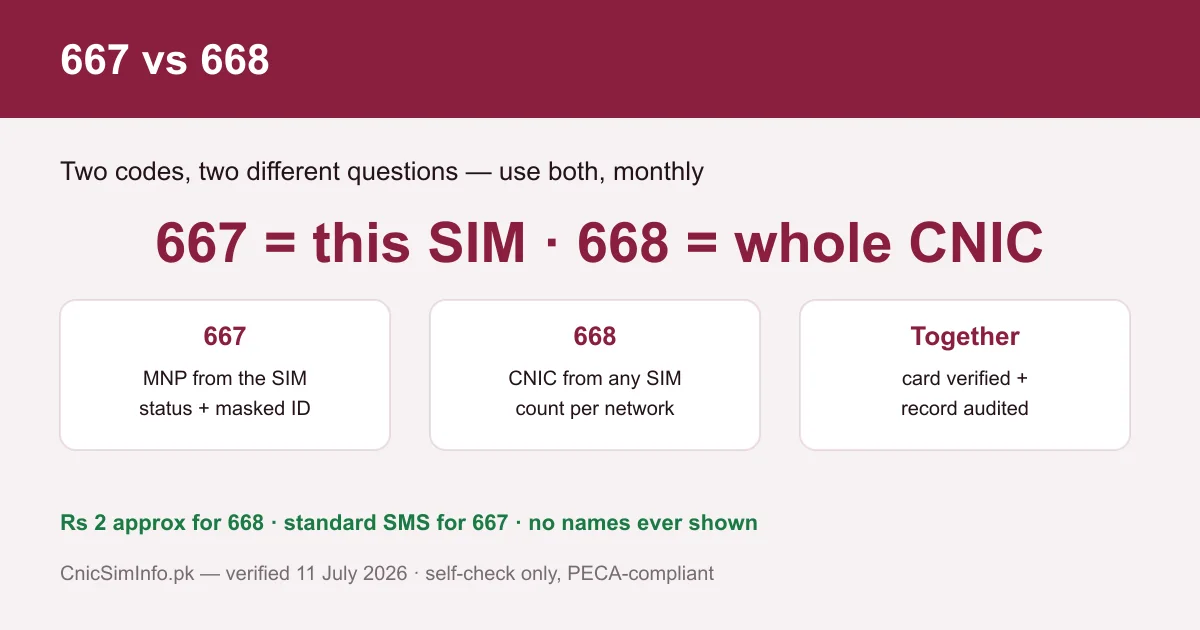
| Question | 667 | 668 |
|---|---|---|
| What it audits | The one SIM that sends the SMS | Every SIM on the CNIC you send |
| What you type | The word MNP | Your 13-digit CNIC, digits only |
| Reply contains | Registration status + masked identity | Per-network SIM counts |
| Cost | Standard SMS rate | About Rs 2 including tax |
| Needs the SIM in hand | Always | Never; any Pakistani SIM can send it |
| Free alternative | None needed; it is near-free | cnic.sims.pk, the official portal |
| Best moment | Before porting; on any doubtful card | Monthly identity audit |
That table settles the 667 vs 668 confusion in one look, but hold on to the deeper point: they are two ends of the same registry. One enters through the card, one through the identity, and disagreements between their answers are exactly the findings worth taking to a franchise.
Five situations, solved
- The drawer SIM. A card surfaces during house cleaning. Seat it, send MNP to 667, read the status, then run 668 to see whether it still occupies a slot on your CNIC. Two minutes, complete picture.
- The used phone. A bought device arrives with a SIM inside. 667 immediately: a card registered to someone else’s record has no business in your daily phone, however convenient the data package looks.
- The porting plan. Run the 667 sim check before filing the request, because registration surprises stall ports at the counter, never at home.
- The family hand-me-down. A parent’s spare SIM moves to a child’s phone. Verify with 667, then remember ownership has not moved: transfers happen at franchises with both CNICs, not by handing over plastic.
- The monthly ritual. Pair 668 on your CNIC with 667 on any card you doubt. The pair costs pocket change and closes the questions that matter, which is the whole philosophy of our methods hub.
The porting-prep checklist
Mobile Number Portability lets your number change operators while keeping its digits, and 667 was built inside that machinery, which is why porting is its home turf. A clean port starts with a clean card.
- MNP to 667 from the number you are porting. Status must read registered, against digits that match your document.
- CNIC to 668 for the wide view. Your target network refuses a sixth voice SIM politely but firmly, since the national cap is eight, five voice plus three data, per the Supreme Court’s 5 November 2015 ruling.
- Biometric health check. An unverified SIM invites friction anywhere identity is re-checked; your network’s status code takes a minute, and every code sits in our master code sheet.
- Original CNIC in hand for the franchise visit. Photocopies scan nothing.
One timing note from the current rules: since PTA’s 24 May 2026 advisory, a newly activated SIM cannot be disowned or transferred for 365 days from activation. That makes pre-port verification the cheap step and post-port correction the expensive one. Our PTA news log tracks that rule with sources.
Three myths about 667, retired
Myth one: 667 reveals who owns any number. It cannot, and the reason is physical. The SMS must leave the SIM being checked, so the only identity 667 ever discusses with you is the one connected to a card in your possession, and even that arrives masked. Full sim owner details for strangers exist behind no code at all, a fact our myths desk has tested against every claim making the rounds.
Myth two: 667 is a Jazz thing, or a Telenor thing. The code is network-neutral because porting is network-neutral; Ufone’s own support pages document the MNP-to-667 flow, and the routine is identical on Jazz, Zong, Telenor and ONIC.
Myth three: it costs real money. One standard-rate SMS. If a website or “agent” wants Rs 300 to run any SIM verification for you, you have found a scam, not a service, and the free-and-official table on our codes master sheet is the antidote.
No reply? The fix ladder
- Check the message body. The word MNP alone, nothing else. Extra words are the most common silent killer.
- Check the SIM’s service. A card with zero signal or suspended service cannot SMS a short code. Give it a minute on the network first.
- Wait, then re-send once. Short-code queues congest at peak hours; a few minutes of patience beats five duplicate messages.
- Escalate to the operator’s helpline from the affected SIM if silence persists; helplines can read what the code reads.
- For a card that fails everything, the franchise counter with your original CNIC is the terminal answer. If the card turns out not to be yours at all, our disowning walkthrough in the methods hub takes over.
Frequently asked questions
What does the 667 SIM check actually reply with?
Registration status for the SIM that sent the SMS, confirmed against a masked identity. You learn whether the card is properly registered and whether the visible fragment matches your own document. No full CNIC, no address, and never anything about a third party.
Can I run a 667 SIM check on someone else’s number?
No. The MNP message must leave the SIM being checked, so the code physically cannot be pointed at a number you do not hold. That design is why 667 stays legal while “lookup” sites do not.
How much does 667 cost?
Your operator’s standard SMS rate, typically a rupee or two. The reply is free. Compare that with 668, which costs about Rs 2 including tax and answers a different question entirely.
Which should I use before porting my number?
667 first, from the SIM you plan to port. A registration mismatch surfaces in the reply before the porting request, which is exactly when it is cheap to fix at a franchise with your original CNIC.
I found an old SIM in a drawer. 667 or 668?
Both, in that order. Insert the SIM and send MNP to 667 to learn its status, then SMS your CNIC to 668 to see whether it still counts against your identity. Unfamiliar entries route through franchise disowning.
Does 667 show the owner’s name of a found SIM?
It confirms registration against a masked identity, which tells you whether the card matches your own document. This is not a tool for identifying strangers, and pulling a stranger’s sim owner details by any route is a PECA Section 16 offence.
Why did 667 send no reply?
Usual causes: the SIM has no service, the message contained extra words, or the network queued the short-code traffic. Re-send the single word MNP after a few minutes, and use the operator helpline if silence continues.
Do 667 and 668 read the same database?
Yes, both read PTA’s Subscriber Verification Management System. 667 enters it from a SIM, 668 enters it from a CNIC, and together they audit the card and the record in about two minutes.
Roman Urdu mein
667 SIM check ka kaam aik hi hai: jo SIM aap ke haath mein hai, us ki registration ki tasdeeq. Us SIM se sirf MNP likh kar 667 par SMS karein (standard SMS rate), jawab mein registration status aur masked shanakht aati hai — kisi ajnabi ka naam kabhi nahi. Porting se pehle, purana phone khareedne par, aur drawer se nikli har SIM par yeh check zaroor chalayein. Poora hisaab chahiye to apna CNIC 668 par bhejein: har network ki ginti aik reply mein. Dono codes wahi PTA registry parhte hain, aur dono sirf aap ke apne record ki baat karte hain.

Written and reviewed by Muhammad Hamza, founder and editor of CnicSimInfo. The 667 flow on this page follows PTA’s MNP framework and the operators’ own published references, re-tested on real SIMs across networks. Last reviewed: 11 July 2026. See our editorial standards.