
News Report · Repeated PTA Advisory
Giving your SIM to another person is a punishable offence, PTA said again on Friday, 24 July 2026. Whatever is done on that SIM is attributed to the person it is registered to. The reporting carried no law section and no penalty figure. PTA had issued the same warning in June 2026. So read this as a repeated advisory on sharing your SIM in Pakistan, not a new rule. The useful half is PTA’s own advice, and it matches the two checks taught across Check SIM Owner Details Pakistan.
Key takeaways
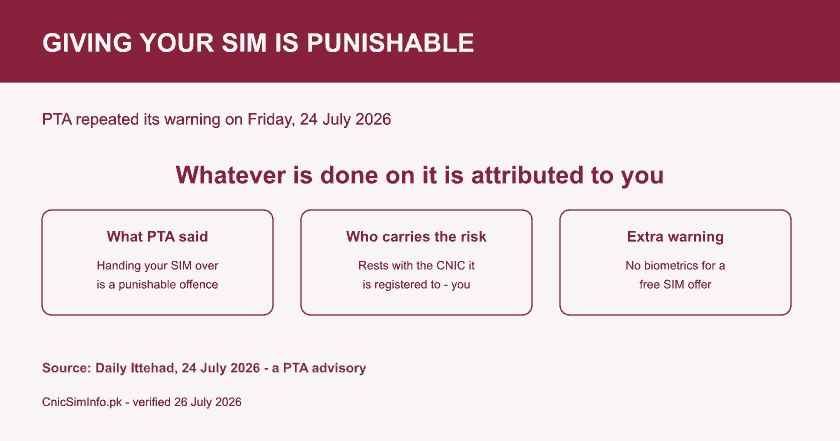
- What PTA said: sharing your SIM in Pakistan is a punishable offence, in a message issued on Friday, 24 July 2026 (Daily Ittehad, 24 July 2026).
- The liability point: responsibility for any activity carried out through a SIM rests with the person in whose name that SIM is registered.
- No statute, no figure: the coverage quoted no section of law, no fine and no jail term. Anyone adding one is guessing.
- Not new: the same warning ran across 4 to 6 June 2026 (Minute Mirror, ARY News, Dunya News, The Nation, Samaa). An earlier version ran in December 2025 (Photo News, 25 December 2025).
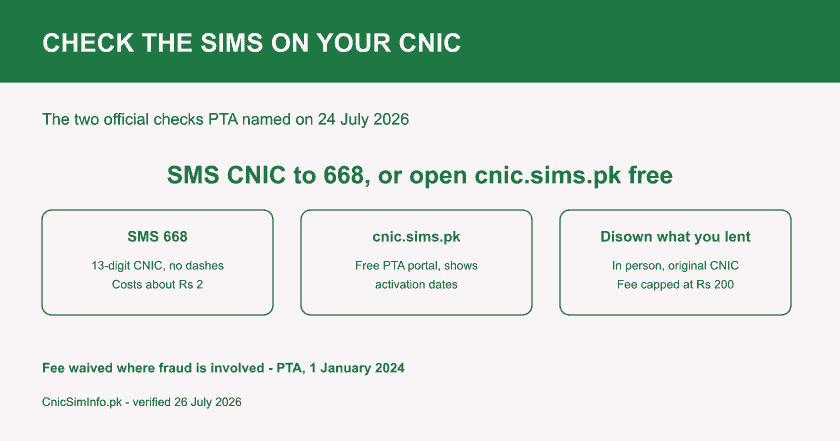
- PTA’s own fix: SMS your CNIC without dashes to 668 (about Rs 2), or open cnic.sims.pk free, then block anything you do not recognise.
One housekeeping note before the detail. This report states what named outlets published, with dates. Where PTA did not cite a law, we do not supply one on its behalf.
What PTA said on 24 July 2026
PTA told mobile users on Friday, 24 July 2026 that providing a SIM card to another person is a punishable offence. Responsibility for any activity carried out through a SIM rests with the individual in whose name that SIM is registered, the regulator said in the same short message (Daily Ittehad, 24 July 2026).
Three practical instructions came with it. Check how many SIMs sit against your CNIC, either at cnic.sims.pk or by sending your CNIC number without dashes to 668. Block any unknown or unnecessary SIM registered in your name. Buy new SIMs only from authorised franchises or customer service centres.
One extra warning travelled with the same message. PTA cautioned against giving biometric verification in return for a free SIM offer. Fraudsters can use those fingerprints to register further SIMs in your name (Daily Ittehad, 24 July 2026). That route sits behind a lot of unauthorised activations. Our biometric verification guide shows how to check your own BVS status per operator.
Sharing your SIM in Pakistan: a repeated advisory, not a new law
Nothing changed in the law on 24 July 2026. PTA ran the same warning in early June 2026, and outlets carried it on 4, 5 and 6 June. A December 2025 version said the same thing about handing over a registered SIM. No numbered circular, gazette notification or dated regulation was published alongside any of them. The wording is strong, but the status is advisory.
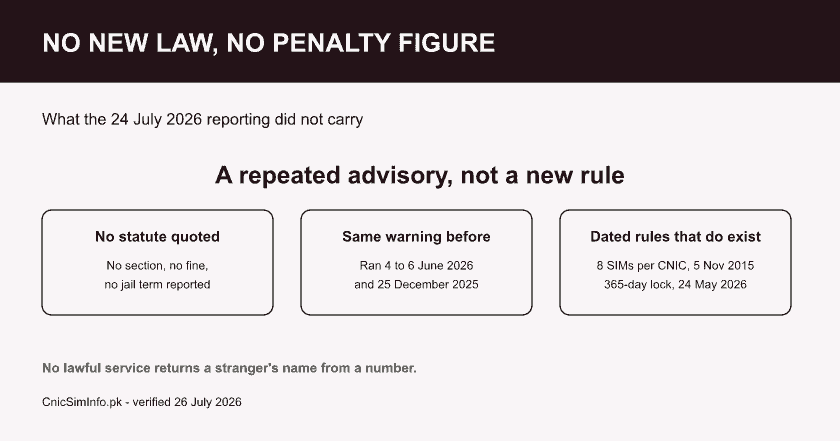
The coverage also cited no statute, no section, no fine and no prison term. We are not going to attach one. Pakistan does have a law on identity misuse, PECA 2016, and our legality explainer sets out what it says. But nothing in the 24 July reporting tied a specific provision to this advisory.
The timing is not random. PTA issued enforcement orders against all four mobile operators dated 13 and 16 July 2026, over SIMs activated on citizens’ CNICs without consent. Press coverage put the headline total at around Rs 740 million. The per-operator amounts published alongside that headline do not add up to it, so we print the headline only. Reporting on 24 July 2026 also described tighter instructions for SIM sales. Our PTA SIM rules timeline keeps the dated sequence, and the PTA SIM news changelog logs each advisory as it lands.
What “attributed to you” means in practice
Attribution means every call, message and data session on a SIM is logged against the CNIC it was registered on. A SIM is an identity record before it is a phone number, so when an investigator starts from a number, the first name they reach is the registered owner’s, not the person who was holding the handset.
So picture sharing your SIM in Pakistan with a cousin, a driver or a shopkeeper. It is used for a scam call, a threatening message, or to open a wallet account. The complaint names that number. You are then the person answering questions, not the person who used it. Clearing that up costs documents, time and nerves, and it is the real price of sharing your SIM in Pakistan.
Two quieter costs are easy to miss. The SIM you handed over still counts inside your allowance of 8 SIMs per CNIC. That ceiling is 5 voice plus 3 data, set by the Supreme Court ruling of 5 November 2015. Our SIM limit per CNIC page explains the split. And any account tied to that number keeps sending its one-time passwords to a handset you no longer hold.
How to give someone a number without lending your SIM
Anyone who needs a number should buy their own SIM in their own name, with NADRA biometric verification against their original CNIC at an authorised franchise. That is the clean route, and it is the only one that keeps the number off your CNIC. Sharing your SIM in Pakistan is rarely sinister. Someone needs a number quickly, a spare SIM is sitting there, and the shortcut is what creates the liability.
If the other person needs your existing number, that is an ownership transfer at the operator counter, not an informal hand-over. One rule limits it. A new SIM cannot be disowned or transferred for 365 days after activation, under the PTA advisory of 24 May 2026. Reporting on 24 July 2026 said biometric verification now also applies to duplicate SIMs, ownership transfer, disowning and number portability. Our 365-day SIM rule page carries the detail.
What to do this week
- Run both checks today. SMS your 13-digit CNIC to 668 for about Rs 2, then open cnic.sims.pk free. Our 668 guide and cnic.sims.pk walkthrough show how to read each reply. For the complete picture, all 12 official methods sit in one guide.
- Match the list against reality. Every number on it should be one you actually use. The full audit routine is on our check SIMs on CNIC page.
- Take back or disown what you lent. Disowning happens in person at the franchise with your original CNIC. The fee is capped at Rs 200 since 1 January 2024, and it is waived where fraud is involved. Steps are in our block and disown guide.
- Treat a genuinely unknown entry as urgent. Our unauthorised SIM on CNIC page sets out the same-week sequence.
- If your name was already used, report it. The NCCIA has run 1799 since 3 June 2025, and complaint.nccia.gov.pk takes the same report in writing. PTA’s consumer helpline is 0800-55055, and its site is pta.gov.pk. It is also worth a minute to check your breach exposure, since leaked CNIC copies feed this kind of misuse.
- Do not go hunting for a stranger’s details. No lawful service returns another person’s name from a number, which our by-number guide explains in full. The SIM database sites that promise otherwise recycle old leaks or invent results.
Sharing your SIM in Pakistan: frequently asked questions
Is it illegal to give my SIM to someone else in Pakistan?
PTA says sharing your SIM in Pakistan is a punishable offence, and it repeated that on 24 July 2026. The reporting quoted no statute and no penalty figure, so treat it as a regulator advisory. The practical risk is plain: anything done on that SIM is attributed to the person it is registered to.
Someone else is using a SIM registered on my CNIC. Am I responsible?
Yes, in the way PTA describes it. The regulator says responsibility for activity carried out through a SIM rests with the person it is registered to. If that number is used for fraud or threats, the trail starts at your CNIC, and you would be the one explaining.
Did PTA announce a new law or a new penalty on 24 July 2026?
No. PTA repeated an existing advisory, and the reporting cited no section of law, no fine and no jail term. Similar warnings ran in June 2026 and in December 2025. Anyone quoting a specific penalty for this message is adding a number PTA did not publish.
How do I check which SIMs are on my CNIC?
Use the two official checks PTA named in the same message. SMS your 13-digit CNIC without dashes to 668, which costs about Rs 2 and returns a count per operator. Then open cnic.sims.pk, which is free and lists the numbers with activation dates. Run both.
Can I transfer the SIM to that person instead of lending it?
Yes, an ownership transfer at the operator counter is the lawful route. Reporting on 24 July 2026 says PTA now wants biometric verification for transfers too. One limit still applies: a new SIM cannot be disowned or transferred for 365 days after activation, under the PTA advisory of 24 May 2026.
Sources: Daily Ittehad (24 July 2026). Earlier runs of the same advisory: Minute Mirror (4 June 2026) · ARY News, Dunya News, The Nation (5 June 2026) · Samaa (6 June 2026). December 2025 version: Photo News (25 December 2025). Enforcement context: PTA Authority’s Determinations, orders dated 13 and 16 July 2026. Press totals were reported 15 to 17 July 2026.