
Claim vs Record
Pakistan SIM Myths, Fact-Checked: 21 Viral Claims vs the Record
Most viral SIM myths in Pakistan circulate as facts. Invented advisories, penalties no statute contains, codes that don’t do what they promise. This sim myths fact check puts 21 of the most-repeated claims against PTA notices, court orders and named press records, one verdict at a time. For the methods that actually work, start at Check SIM Owner Details Pakistan.
Key takeaways
- 21 viral claims, each tested against PTA notices, court orders and named press.
- No dial code shows “all SIMs on a CNIC” — the *321#-family does a different job entirely.
- No owner-finder exists, free or paid; obtaining one is the Section 16 offence itself.
- The codes that do work are collected at the methods hub.
- Every verdict here carries a date and a source.
Every verdict below follows the same pattern: the claim as it circulates, what the record actually shows, and where that record lives. No anonymous sourcing, no “everyone knows”. If we can’t trace a number to a named source, we treat it as invented, and we say so.
On this page
Policy and date SIM myths
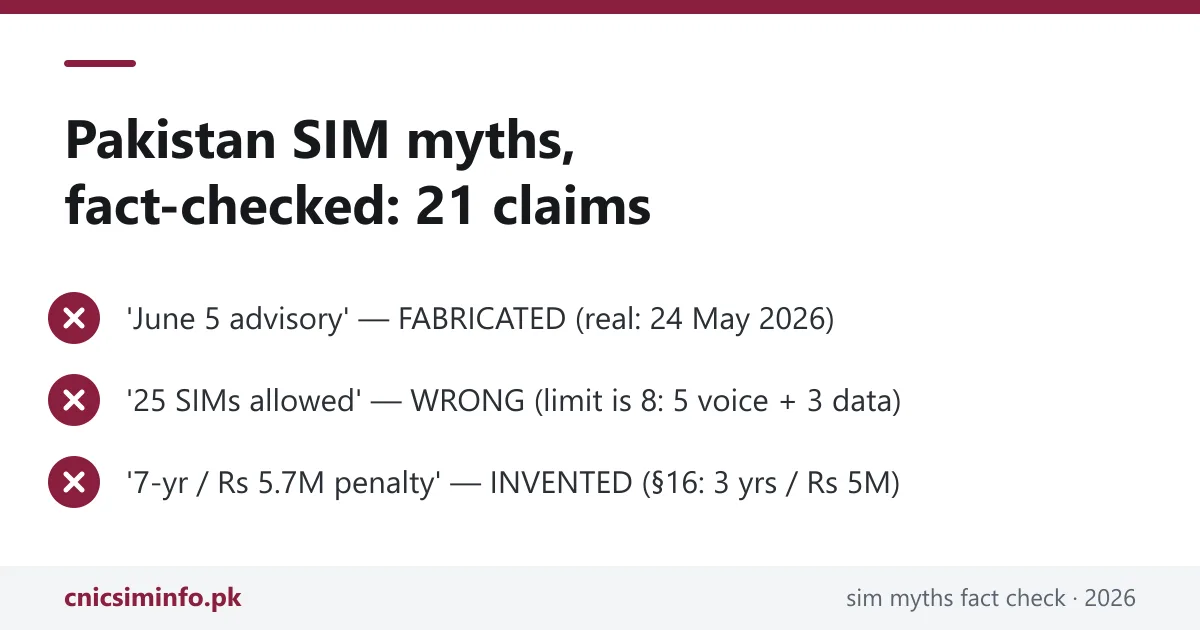
1. “PTA issued a June 5, 2026 SIM advisory”
FabricatedNo June-5 circular exists anywhere in PTA’s record.
The real chain is fully documented: PTA’s letter to operators (L-7646, the gazette-notified amendment regulations) is dated 11 May 2026; the public advisory followed on PTA’s official X and Facebook on 24 May 2026, with The Nation covering it that same evening. Its Director General confirmed it to Geo Fact Check, whose “True” verdict landed on 4 June, and the wider press picked the story up on 25 May. Sites citing “June 5” copied each other, not PTA — the full source trail sits in the changelog entry.
2. “Operation Clean Sweep 3.0 blocked 3.1M SIMs in Q1 2026, with 72-hour auto-suspensions”
FabricatedNo PTA statement or press record mentions any “Clean Sweep” operation or a 72-hour auto-suspend rule.
Real enforcement, per ProPakistani‘s 2 January 2026 review of Jul 2024 to Jun 2025: 3.2M SIMs on deceased CNICs blocked, 783,000 on expired CNICs blocked, and 891,000 dormant numbers recycled. The real numbers are dramatic enough; nobody needed to invent an operation.
3. “4.8 million unauthorized SIMs were suspended in January 2026”
FabricatedThis figure drifts between 4.7M, 4.8M and 5.3M depending on which site you read, and none of them names a source.
The closest documented figure: PTA flagged 4,906,611 SIMs tied to expired or deceased CNICs for phased action, announced 17 June 2025 (ProPakistani). Different number, different date, different meaning.
4. “The Supreme Court set the SIM limit in 2024”
Wrong yearThe order is from 5 November 2015, under Chief Justice Anwar Zaheer Jamali (reported by Express Tribune, 6 November 2015).
That’s the ruling behind today’s cap of 5 voice + 3 data SIMs per CNIC. A decade old, still in force.
5. “The SIM limit was reduced to 6 in December 2025”
FabricatedNo such change happened: the limit remains 8 per CNIC, 5 voice + 3 data.
Dial back to the source of truth: PTA’s own SIM Information pages state the cap, and 668 counts your SIMs against it. Rule changes get dated entries in our PTA SIM news changelog; December 2025 has none.
6. “You can have 25 SIMs: 5 per network”
WrongThe cap is combined across all networks, not per operator — eight total, 5 voice + 3 data.
That “5 per network = 25” math comes from misreading the 2015 order. Foreigners on passport get 2; corporate SIMs run on NTN, outside the personal cap.
7. “SIM disowning takes 17 days”
InventedNo PTA service-level agreement of 17 days exists anywhere.
The verified process: visit the operator’s franchise with your original CNIC, biometric verification, fee up to Rs 200 (waived in fraud cases, per PTA’s 1 January 2024 notice), and records typically update within 24 to 48 hours.
Code and tool SIM myths
8. “*321#, *345# or *333# show all SIMs on your CNIC”
Wrong functionThose are operator menu and balance codes, blind to anything outside their own network.
Only two channels read the national registry for you: SMS your CNIC to 668 (about Rs 2) or check cnic.sims.pk (free). Everything else is a different tool for a different job; all 12 legal channels sit side by side on the methods hub.
9. “667 reveals any owner’s name, CNIC and address in 6 seconds”
Overstated667 is a pre-porting verification of the SIM physically in your hand, per PTA’s MNP guidelines. The reply shows the number’s registration status against a masked CNIC.
It cannot look up strangers, and it never prints an address. Anything promising that is describing a crime, not a shortcut.
10. “668 is free”
WrongThe SMS costs about Rs 2 including tax. The free official check is the portal, cnic.sims.pk, which also shows activation dates and works worldwide.
11. “Text 7622 to report spam”
Wrong codeThe PTA spam-reporting code is 9000: forward the spam message, then the sender’s number.
12. “SMS 8300 to check your CNIC status”
Wrong service8300 is the Election Commission’s voter-information service. NADRA’s tracking service is 8400, and NADRA’s helpline is 1777 — none of them a “CNIC status” check.
13. “Call the helpline and they’ll tell you who owns a number”
False + illegal framingOperator helplines (Jazz 111, Zong 310, Telenor 345, Ufone 333, SCO 355) verify the caller’s own SIM. Disclosing a third party’s identity would put the operator inside PECA Section 16.
Guides suggesting you can “check a friend’s details” this way are teaching an offence. The legal line is drawn on our PECA 2016 page.
Law and penalty SIM myths
14. “The penalty is 7 years and Rs 5.7 million”
Invented mathNo section of PECA 2016 produces that figure. The real maximums: Section 16 (identity misuse) 3 years / Rs 5M; Section 17 (unauthorized SIM issuance) 3 years / Rs 500k; Section 3 (unauthorized access) 3 months / Rs 50k; Section 4 (unauthorized copying) 6 months / Rs 100k.
That “7-year” family stitches unrelated sections together. The corrected table, with the statute’s own wording, lives on the legality page.
15. “Only the website owner breaks the law, not the person searching”
WrongSection 16’s verbs are “obtains, sells, possesses, transmits or uses”. The person running the search is inside the wording from the first verb.
16. “Report SIM fraud to FIA’s 1991 helpline”
OutdatedCybercrime moved from FIA to the NCCIA, whose helpline 1799 launched 3 June 2025, with complaint.nccia.gov.pk as the portal. Pages still routing readers to 1991 haven’t been updated in over a year.
Database and big-number SIM myths
17. “Pakistan has 198M active SIMs”
Wrong numberPTA’s figure was 204.771 million active subscribers at the end of February 2026 (via PhoneWorld and TechJuice). Sites quoting “198M+” are recycling an old or invented figure.
18. “Rs 22.5B SIM fraud, a 137% SIM-swap rise, 96,000 FIA complaints”
UnsourcedThese numbers appear on lookup-site networks with no named source, and they drift between that network’s own pages.
Documented alternatives exist: PKCERT’s May 2025 advisory on 184M+ leaked credentials (a global infostealer set, not a SIM database), and the 139 data-selling platforms an NCCIA-led probe uncovered and got blocked by October 2025.
19. “A fresh, live SIM database is available online”
ScamSVMS, the only real registry, has no public API for anyone. “Fresh databases” recycle breach data or fabricate results; the full anatomy is on the pak sim data page.
Enforcement backs this up: 83 illegal SIM-sale sites blocked in a year, 1,372 personal-data sites and apps reported blocked by September 2025. Using what remains is a Section 16 act with your name on it.
20. “Pakistan uses CEIR to block stolen phones”
Wrong countryCEIR is India’s system, while Pakistan runs DIRBS for device compliance and LSDS for lost-phone blocking; check any handset by texting its IMEI to 8484. The full jargon set is decoded in our glossary.
21. “DIRBS enforces the SIM limit”
Wrong systemDIRBS governs devices by IMEI; the SIM cap is enforced at activation, when NADRA biometrics and the SVMS registry check your CNIC’s count before a new SIM can go live.
Why these SIM myths exist
Follow the money and the pattern is plain. Invented advisories and giant fraud numbers create urgency. Urgency drives searches. And the pages ranking for those searches often sell the very thing the law forbids: “premium” lookups over WhatsApp, database access, APK downloads. The scarier the myth, the better their funnel converts.
That’s why our rule is boring on purpose: a claim only survives this site if it traces to a named source (a statute, a PTA or NADRA notice, a court order, or named national press). Everything else gets a verdict here. Our Editorial Standards spell out the whole test, and this sim myths fact check gets re-verified on schedule with the rest of the site.
Frequently asked questions
How do you decide a claim is fabricated?
Two-source minimum for statistics, primary sources first: statute, court order, PTA/NADRA/NCCIA notice, then named national press. If a figure appears only on lookup sites and drifts between their own pages, it’s treated as invented.
Could a myth become true later?
Rules do change; that’s different from a fabricated record. When PTA actually changes something (like the 24 May 2026 advisory), it gets a dated, sourced entry in our changelog within days. A claim without a record stays a myth.
What’s the safest way to check my own SIMs?
SMS your 13-digit CNIC to 668 (about Rs 2) or use cnic.sims.pk free. Both are official PTA channels and both work only on your own identity, which is exactly why they’re legal.
I found a site spreading one of these myths. Where do I report it?
If it sells data or lookups, report it to PTA (0800-55055 or complaint.pta.gov.pk) or NCCIA (1799, complaint.nccia.gov.pk). And when the error is ours, use the corrections lane on our contact page; credited fixes are part of how this site works.
Roman Urdu mein
Jo bhi page “June 5 policy”, “25 SIM ki ijazat”, “7 saal saza” ya “live database” bataye, samajh jayein ke ghalat hai. Asli record: advisory 24 May 2026, limit 8 (5 voice + 3 data, Supreme Court 5 Nov 2015), saza Section 16 mein 3 saal / Rs 50 lakh tak, aur koi legal public database exist nahi karta. Apna check sirf 668 ya cnic.sims.pk se karein.

Written and reviewed by Muhammad Hamza, founder and editor of CnicSimInfo. These SIM myths verdicts trace to the PECA 2016 statute, PTA and NADRA notices, the Supreme Court order of 5 Nov 2015, PKCERT and NCCIA records, and named press (Geo Fact Check, Express Tribune, Dawn, ProPakistani). Re-verified quarterly. Last reviewed: 8 July 2026. See our Editorial Standards.