
Family Guide · Under-18 Lines
SIM for Minors in Pakistan: B-Form Rules and the Guardian’s Cap
No Pakistani operator issues a SIM on a B-Form — under 18, the SIM goes on a parent or guardian’s CNIC instead. It counts toward that adult’s cap of eight, five voice plus three data. At 18 the child gets a CNIC and takes ownership at the franchise. The full toolkit sits at Check SIM Owner Details Pakistan.
Key takeaways
- A B-Form is a school and travel document, not a SIM document — no operator registers a line against one.
- A child’s SIM sits on the guardian’s CNIC and spends one slot of that adult’s 8-SIM cap.
- The cap splits five voice + three data, and a tablet’s data SIM burns a data slot like any dongle.
- At 18 the child gets a CNIC and takes ownership at the franchise: both present, both verified by fingerprint.
- Newly issued SIMs carry a 365-day transfer lock (PTA advisory, 24 May 2026) — plan the handover, not just the birthday.
One boundary before the practical part: these tools cover your own family’s records. Digging into SIM details of people outside them is a criminal offence under PECA 2016 Section 16, mapped in full on our legality page.
On this page
The rule: no SIM on a B-Form
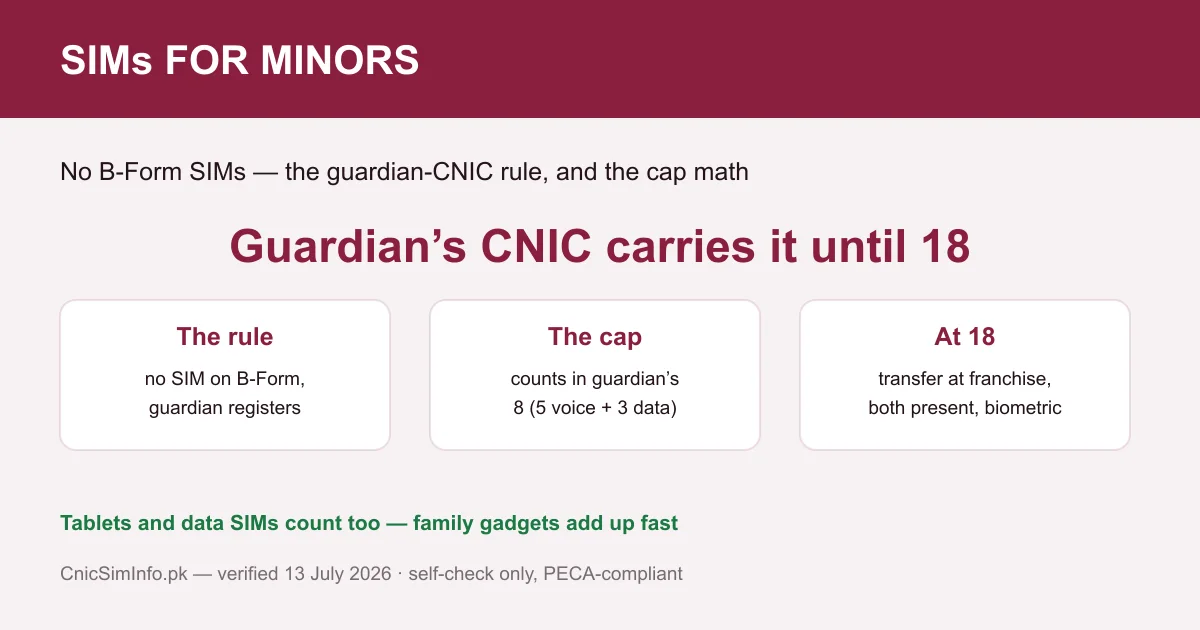
Pakistan’s SIM registration runs on a CNIC plus live fingerprints. A B-Form offers neither a photo the counter can match nor prints the verification device can read. So the rule holds across Jazz, Zong, Telenor, Ufone and SCOM alike: under 18, no SIM in the child’s own name. No franchise bends it.
The official route is what families already do. A parent or guardian buys the SIM on their own CNIC, hands the child the handset, and remains the registered owner of the line. Every OTP, recharge and complaint runs through the adult’s name until the child grows into a CNIC of their own.
Cap math for a family of gadgets
Now the arithmetic, because the cap is per CNIC, not per household. Since the Supreme Court’s ruling of 5 November 2015 the ceiling is eight SIMs per CNIC, five voice and three data. A child’s line spends those slots exactly as an adult’s does.
| Family setup on one CNIC | Voice slots used | Data slots used |
|---|---|---|
| Parent’s own phone | 1 | — |
| Two children’s phones | 2 | — |
| School tablet SIM | — | 1 |
| Home internet dongle | — | 1 |
| Running total | 3 of 5 | 2 of 3 |
Data SIMs are the quiet slot-eaters. The tablet a school insists on and the dongle behind the router both draw from a pool of just three. Households with several gadgets split lines across both parents’ CNICs early, before the cap turns a birthday gift into a franchise errand.
One more timing rule for the planners: under a PTA direction effective 24 January 2024, a second new SIM on the same CNIC comes with a seven-day NADRA wait after the first. Buying every child a line in one afternoon is not how the counter works.
Keeping count of the family’s lines
Whichever CNIC carries the family’s lines deserves a monthly count, done the registry’s way. SMS the CNIC to 668 for about Rs 2, or use the free PTA portal at cnic.sims.pk, which adds each SIM’s activation date. Replies are decoded in the 668 guide and the count decoder; the portal has its own walkthrough.
An entry no family device explains is not a rounding error. Head for the unknown-SIM guide and, where the line truly is not yours, the block-and-disown steps. A slot a teenager simply abandoned is gentler work. That is the extra-SIM deactivation route, and it frees room for the next gadget.
At 18: the ownership transfer
- The child turns 18 and gets a CNIC from NADRA.
- Guardian and child visit the operator’s franchise together, original CNICs in hand.
- Both verify by fingerprint; the registration moves to the child’s CNIC.
- A slot frees on the guardian’s record — confirm with a 668 check after a few days.
The handover is a counter job, both parties present, both thumbs on the BVS device. One timing note from PTA’s advisory of 24 May 2026: freshly issued SIMs carry a 365-day lock against transfer and disowning. A line bought new for the eighteenth birthday therefore waits a year. The SIM carried through school can move the week the CNIC arrives.
Why registered beats informal
Ownership carries the keys along with the responsibility. If a child’s number lands in the wrong hands, the registered guardian can have the operator block it at once. Where harassment or fraud touches the line, the NCCIA takes reports on 1799. Scam texts forward to PTA’s 9000 service from any handset.
That is the quiet argument for doing this by the book. A SIM picked up informally in some stranger’s name gives a family none of those handles, and it hands a teenager a line whose registered owner is a stranger — the exact setup our myth-check page keeps warning about.
Roman Urdu mein
Pakistan mein B-Form par SIM nahi milti — 18 saal se pehle bachon ki SIM walid ya guardian ke CNIC par hoti hai. Aur woh SIM us bade ke 8-SIM cap mein ginti hai: 5 voice, 3 data. Tablet ki data SIM bhi data slot leti hai, is liye ghar ke devices dono waldain ke CNIC par baant lein. Mahine mein aik dafa 668 par CNIC SMS kar ke ya cnic.sims.pk se ginti dekh lein. Jab bacha 18 ka ho kar CNIC bana le to franchise par dono ja kar biometric se ownership transfer karwa lein. Yaad rahe: nai kharidi hui SIM par 365 din ka transfer lock hota hai, purani par nahi.
Frequently asked questions
Kya B-Form par SIM mil sakti hai?
Nahi — Jazz, Zong, Telenor, Ufone, koi bhi operator B-Form par SIM issue nahi karta, kyunke registration ke liye CNIC aur live fingerprints chahiye. Bachon ki SIM walid ya guardian apne CNIC par lete hain, aur woh SIM 8-SIM cap mein ginti hai; yehi official tareeqa hai.
Does my child’s SIM count against my 8-SIM limit?
Yes. The cap is counted per CNIC, so every line you register for a child occupies one of your eight slots. It stays on your record, five voice and three data in all, until ownership transfers at 18 through a biometric visit to the franchise.
Do tablet and school data SIMs count too?
They do, inside the data pool of three. A data SIM has no voice number attached, but it is registered against the guardian’s CNIC the same way. The dongle in the drawer and the school tablet both spend slots a 668 check will list.
How does the SIM become my child’s at 18?
Once the CNIC is issued, both of you visit the franchise with originals and verify by fingerprint on the BVS device. The registration moves to the child’s CNIC and your slot frees. Confirm afterwards with a 668 check on both records.
What is the 365-day lock, and will it delay the handover?
PTA’s 24 May 2026 advisory bars newly issued SIMs from transfer or disowning for 365 days. A SIM the family has held for years is well past that window; only a line bought fresh for the birthday has to wait out the year.

Written and reviewed by Muhammad Hamza, founder and editor of CnicSimInfo. The eight-SIM cap traces to the Supreme Court ruling of 5 November 2015 and the 365-day lock to PTA’s advisory of 24 May 2026; the B-Form rule reflects uniform operator counter practice. Last reviewed: 13 July 2026. See our editorial standards.