
Free, Legal & Official — Updated August 2026
SIM Owner Details — Check Your CNIC’s SIMs Free & Legally in Pakistan (2026)
How do you check SIM owner details in Pakistan? Text your NADRA-issued 13-digit CNIC (no dashes) to 668, or use PTA’s free portal cnic.sims.pk. In about 30 seconds, you get a count of every SIM on YOUR CNIC, network by network. You can only check your own CNIC. Looking up a stranger breaks Section 16 of PECA 2016.
Pakistan keeps one national SIM registry. It’s called SVMS, PTA’s record system, and it sits behind 208,057,255 active cellular subscribers as of June 2026, per PTA telecom indicators, across every operator — Jazz, Zong, Telenor, Ufone, SCO and ONIC. This page is the full manual for your own SIM owner details. People search for SIM information, SIM details and SIM ownership; all three mean the same PTA record. It covers all 12 official methods, the 8-SIM limit and the new 365-day rule. It also shows what to do when the count looks wrong.
See all 12 official methods Open cnic.sims.pk (free)
cnic.sims.pk costs nothing. The 668 SMS costs about Rs 2 with tax. That check never costs more than a text.
Every official ownership check works on your own CNIC. No legal tool shows a stranger’s name from a number. That’s a PECA 2016 offence.
Start Here
The 30-second answer (read this first)
What’s the fastest way to check SIM owner details on your CNIC? Text your NADRA-issued 13-digit CNIC (no dashes) to 668 (about Rs 2 with tax). PTA replies in about 30 seconds with the SIM owner details count for your CNIC, network by network. Prefer a screen? Open PTA’s free portal cnic.sims.pk. You can only check your own CNIC.
That one reply is your whole SIM registration audit. One SMS, and you know exactly where you stand. Does the count match the SIMs you actually use? Then you’re done for the month. Save the screenshot and move on.
If any network shows more SIMs than you remember buying, don’t panic. This page walks you through the fix: the helpline call, the franchise visit, and the PTA complaint that puts your side on record.
Two more codes finish the SIM owner details toolkit. Send MNP to 667 from any SIM in your phone to confirm that one SIM’s registration. And to learn which network runs a number, text it to 76367 as N 03XXXXXXXXX. The N at the start matters, and most guides skip it.
Full walkthroughs live in the 668 guide and the portal guide, or jump to all 12 official SIM owner details methods below.
Try It First
Free SIM & CNIC Checker (advisor — no lookup)
Which official method should you use? Tell this advisor what you want to do. It points you to the right PTA channel for your SIM owner details. Use 668 or cnic.sims.pk for all SIMs on your CNIC. Use 667 for the SIM in your hand, and 76367 for a number’s network. It runs in your browser and stores nothing.
This advisor is a router, not a search box. No database sits behind it. That’s the whole reason this site stays legal while “lookup” sites keep getting blocked.
What do you want to do?
This tool doesn’t look anything up. Nothing you pick leaves your browser. No data is stored, no database is touched. It only tells you which official PTA method fits your case. Independent site, not affiliated with PTA, NADRA or any operator.
The Difference
668 vs cnic.sims.pk vs 667 vs 76367 — quick compare
What’s the difference between the SIM-check codes? 668 gives you a SIM owner details count for your CNIC. The portal shows the same count free, worldwide, with activation dates. 667 checks only the SIM in your own hand. 76367 names a number’s current network. None of them shows a stranger’s identity.
| Tool | Looks at | Returns | Cost | Works overseas? |
|---|---|---|---|---|
| 668 (SMS: 13-digit CNIC, no dashes) | Your CNIC | Per-operator SIM owner details count | About Rs 2 with tax | No, needs a Pakistani SIM |
| cnic.sims.pk (web portal) | Your CNIC / NICOP | Same count on screen, plus activation dates | Free | Yes, worldwide, no VPN |
| 667 (SMS: MNP) | The SIM in your hand | That SIM’s network and status, plus a masked CNIC you can match to your own | Standard SMS | Only with that SIM active |
| 76367 (SMS: N 03XXXXXXXXX) | Any 11-digit number | Its current network only, never a name | About Rs 2 with tax | No, needs a Pakistani SIM |
Think of them as four lenses on one SIM owner details registry. 668 and the portal look at your identity and count everything under it. 667 looks at one physical SIM. 76367 looks at a number and names only its operator. Start with 668 or the portal, then use 667 on any SIM you’re unsure about. There’s a deeper side-by-side on our 667 vs 668 page.
Roman-Urdu: 668 aur cnic.sims.pk aapke CNIC par tamam SIMs ka count dete hain. 667 sirf aapke haath wali SIM verify karta hai. 76367 kisi number ka network batata hai. Pehle 668 se poora hisaab dekhein, phir shak wali SIM 667 se confirm karein.
Is the 668 SMS or cnic.sims.pk better?
Both read the same PTA registry and return the same per-operator count. Use 668 for a fast answer from any Pakistani SIM, about Rs 2 with tax. Use cnic.sims.pk when you want it free, need activation dates, or are checking from abroad on a CNIC or NICOP.
Does sending MNP to 667 reveal the owner’s name?
No. Sending MNP to 667 confirms the registration of the SIM physically in your phone and shows a masked CNIC you can match to your own. It never returns a name, a full CNIC, or an address, and it cannot be aimed at anyone else’s number.
Trusted
Trust badges — verifiable promises
Is this site official and safe? CnicSimInfo is an independent guide, not a government or PTA website. The only official PTA portal for SIM owner details is cnic.sims.pk. Sites that brand themselves the “PTA official website” while asking for a stranger’s number are neither official nor legal. We teach PTA and NADRA methods only: zero CNIC storage, no lookup, no data sales, and dated figures — 208,057,255 cellular subscribers in June 2026, per PTA.
Each badge is a promise you can test yourself. Every code here comes from PTA or the operators, not from us. The free SIM and CNIC checker on this page sends nothing anywhere. And the subscriber badge carries PTA’s actual number, not the rounded figure that still circulates on unofficial sites. Our rules live on the Editorial Standards and About pages.
Quick Start
Choose your situation (intent router)
What do you want to do? See all SIM owner details on your CNIC: 668 or the portal. Verify the SIM in your hand: 667. A number’s network: 76367. Remove an unknown SIM: the action plan. Block a lost SIM or phone: the block section. Fraud: NCCIA 1799.
Fresh & Dated
What changed recently (dated)
What are the newest SIM owner details rules? A 365-day disowning lock on new SIMs (late May 2026). A ban on new-SIM sales from midnight to 6 AM (19 May 2026). The PTA Digital Assistant on WhatsApp 0315-0055055 (26 February 2026). And the PTCL–Telenor merger, completed 1 July 2026. In late July 2026 PTA also penalised all four operators, tightened how SIMs may be sold, and warned that handing your SIM to someone else makes you answerable for it.
- Late May 2026: a newly activated SIM can’t be disowned or transferred for 365 days (it used to be 60). The full story and the date proof.
- 19 May 2026: new-SIM sales are banned nationwide between midnight and 6 AM. Your checks still work 24/7.
- 1 July 2026: Telenor Pakistan merged into PTML, the company behind Ufone. What it means for your codes.
Dated advisories are archived in the PTA SIM news changelog. We update it weekly.
What It Means
What exactly are “SIM owner details”?
What do SIM owner details include? “SIM owner details” is the registration record PTA creates when a SIM is biometrically activated against your CNIC (a NADRA fingerprint match). It ties one SIM to one identity, and the SIM owner details record covers core details such as your name, your 13-digit CNIC, the network and the activation date, plus the SIM’s verification status. Public checks (668 and cnic.sims.pk) return only a count per network on your CNIC, never the full record.
That design is worth a pause, because it explains this whole page. Run a check on your own CNIC and even you get just a count. No phone numbers. No address. The registry has no public window that shows anyone’s full record.
So when a website claims it can sell you a stranger’s SIM owner details, you already know it’s lying. The data it promises isn’t reachable, for anyone.
People say “SIM ownership”, “SIM ownership information”, “SIM info on CNIC”, “registration record” or “SIM owner details” for the same thing. One record, many names. Full definitions live in the glossary.
The Record
What the SVMS record covers
What does the SIM owner details registry record? The SIM owner details record typically ties your identity to each SIM. It holds your name (as printed on the CNIC), your CNIC number, the network and the activation date. It also holds the SIM’s verification and status, plus the total count per CNIC. Notice what replies leave out: numbers, names, addresses. That’s privacy by design.
- Owner’s full name, exactly as printed on the CNIC.
- The 13-digit CNIC number. Every SIM hangs off this one anchor.
- Network operator: Jazz, Zong, Telenor, Ufone, SCO or ONIC.
- Activation date. The portal shows it, and it starts the 365-day clock.
- Biometric status: whether NADRA’s fingerprint check is complete.
- SIM status: active, blocked or disowned, plus the total SIM owner details count on that CNIC.
Same Thing?
“SIM info” vs “SIM data” vs “SIM details”
Are these all the same? For your own CNIC, yes. One SIM owner details record, many phrasings. But “Pak SIM Data” is different. That’s a brand of illegal lookup site built on fake or leaked data, not the official record. We cover it honestly further down.
Type “SIM information”, “SIM info”, “SIM data”, “SIM owner information” or “SIM details” into Google and you land in the same place: your registration record. Every phrasing leads to the same official SIM owner details checks, 668 and the portal. The same goes for “SIM ownership”: it simply names the CNIC-to-SIM link those checks read.
The one phrase to treat with care is “Pak SIM Data”. That’s not a kind of record. It’s a family of lookup sites, and it belongs in the warning section, not the methods list. Three of the best-known names, PakSim GA, PakData CF and PakSim Pro, are now dead domains, and the app sold as Minahil Sim Data works the same way.
| What you type | What it really means | Where it points |
|---|---|---|
| SIM information / SIM info | The registration record on your CNIC | Your own count via 668 or cnic.sims.pk |
| SIM data | The same record — but “Pak SIM Data” means illegal lookup sites, not the official one | Official checks only; treat “Pak SIM Data” as a warning |
| SIM owner details | The name and registration status tied to a SIM | Your own CNIC via 668 or the portal; full record at a franchise |
| SIM verification | Confirming a SIM is biometrically registered to you | Send MNP to 667 for the SIM in hand, or a BVS code (Method 5) |
| SIM network check | Which operator runs a number today (prefixes lie after MNP) | 76367, N-format — names the network, never an identity |
The System
PTA’s SIM Information System (the “sim info system” people search for) (SVMS), explained
What is the SIM Information System? SVMS is PTA’s backend SIM owner details registry. It powers both 668 and cnic.sims.pk, and it links every verified SIM in Pakistan to a CNIC. That link is what makes your own SIM owner details audit possible, and what makes a fake SIM on your name visible.
Here’s the flow in one line. You buy a SIM. NADRA’s biometric system (MBVS) matches your fingerprint to your CNIC. The activation gets written into SVMS. From that moment, any 668 or portal check on your CNIC includes that SIM in its count.
One registry, two public windows, and a fingerprint gate at the door. That’s why the count you get back is solid enough to act on. It is also why any genuine SIM information check must start from a CNIC: the registry is indexed by identity, not by phone number.
It’s also why a fake SIM can’t hide. A SIM can’t enter the registry without landing on somebody’s CNIC. If a fraudster puts one on yours, your count goes up. The monthly check exists to catch exactly that.
Behind the Scenes
How the three systems cooperate (and what DIRBS is NOT)
NADRA vs SVMS vs DIRBS — who does what? NADRA’s MBVS proves you’re you. SVMS records the SIM-to-CNIC link. DIRBS handles devices by IMEI. The SIM cap is enforced at activation through SVMS and NADRA, not by DIRBS, whatever some guides say.
- NADRA / MBVS proves the person: your fingerprint (or the Rs 20 facial fallback) matched to your CNIC.
- SVMS records the ownership: the SIM-to-CNIC link that 668 and the portal read.
- DIRBS governs the handset: device identity by IMEI, checked via 8484. It’s Pakistan’s system. CEIR is India’s.
One correction worth spelling out, because plenty of guides get it wrong. DIRBS doesn’t enforce the SIM limit. A ninth SIM simply fails at activation, through SVMS and NADRA. DIRBS decides whether a phone may use Pakistani networks. It has nothing to do with how many SIMs sit on your CNIC.
Your Record
“SIM card owner details” — your record, on demand
What are SIM card owner details? The ownership entry tied to each SIM: the holder’s name and registration status. You can see the SIM owner details count for your CNIC through 668 or the portal. A franchise can print the full SIM owner details record after a fingerprint match.
This is the search people run while holding a physical SIM and wondering whose name sits under it. The self-serve answer is the pair you already know: 668 for the count, 667 for the SIM in your hand.
Need more than a count? A printed record, a correction, a transfer? That’s franchise territory. Take your original CNIC, give a fingerprint, and the staff can pull the complete record for SIMs on your identity. Method 8 below covers what to bring.
Speak the Language
Glossary chips (tap to expand)
SVMS, BVS, DIRBS, MNP, NICOP — what do they mean? SVMS is PTA’s SIM owner details registry (SIM-to-CNIC). BVS/MBVS is NADRA’s fingerprint step. DIRBS is the device system (Pakistan’s, not India’s CEIR). MNP means keep your number, switch networks. NICOP and POC are overseas ID cards, and both work on the portal.
SVMS — Subscriber Verification Management System
PTA’s national registry. It links every activated SIM to a CNIC, powers 668 and cnic.sims.pk, and has no public API. It’s the one true source of SIM owner details in Pakistan. Nothing on a lookup site comes from it. The registry answers only for the CNIC you can prove is yours.
BVS / MBVS — biometric verification
NADRA’s fingerprint system. It’s the step that activates a SIM and ties it to a CNIC. You can check your status with your operator’s BVS code. See Method 5. NADRA added a facial-recognition certificate in January 2026, priced at Rs 20, for cases where fingerprints fail.
DIRBS — the device side
The Device Identification, Registration and Blocking System. It governs handsets by IMEI (SMS yours to 8484). It’s Pakistan’s system, CEIR is India’s, and it doesn’t enforce the SIM limit. Dial *#06# to read your IMEI, then send it to 8484 before buying any used phone.
MNP — Mobile Number Portability
Keep your number, change networks. It’s why prefixes mislead. A 0300 number may live on Zong today. That’s the reason 667 and 76367 exist. Send MNP to 667 for the SIM in your hand. Send N 03XXXXXXXXX to 76367 for a number’s current network.
NICOP / POC — overseas identity
The overseas-Pakistani and Pakistan-origin cards. Both work exactly like a CNIC on cnic.sims.pk. That makes the portal the overseas route of choice. Enter the card number and the CAPTCHA, and the count appears with activation dates. No VPN is needed.
SIM Disowning — the counter-phrase
The franchise process (fingerprint, in person) that removes a SIM from your CNIC. Say those exact words at the counter. Keep the written reference number. The fee is capped at Rs 200, and it is waived when the SIM was issued fraudulently.
These chips cover the terms that matter most. Full definitions live on the glossary page.
Step by Step
All 12 official methods (most guides stop at 10)
How do you check SIM owner details, every official way? The 668 SMS. The cnic.sims.pk portal. MNP to 667. Own-number codes. BVS biometric codes. Every one of these SIM owner details methods, verified and dated, sits on our complete codes reference. Operator apps. Operator helplines. The franchise. 76367. PTA’s channels (0800-55055 and the CMS app). The PTA Digital Assistant on WhatsApp. And NADRA’s identity channels (1777, Pak-ID, 8400). All free or near-free ways to read who your own SIMs belong to.
Most guides list ten routes at best. Two more genuinely belong here: PTA’s WhatsApp assistant, new in February 2026, and NADRA’s identity channels. Why NADRA? Because half of all SIM problems are really CNIC problems in disguise. And there is no secret thirteenth method. Any site that promises an owner’s name from just a number is unofficial, and it breaks PECA 2016 Section 16. These twelve routes are the complete lawful set.
Jump straight to any SIM owner details method:
- SMS your CNIC to 668 — the classic check
- cnic.sims.pk — free, worldwide, shows activation dates
- MNP to 667 — the SIM in your hand
- Your own number, free — all-network codes
- BVS biometric status — with the Ufone code question, settled
- Operator apps — Jazz World, My Zong, My Telenor, My Ufone, ONIC
- Operator helplines — identity-checked support
- The franchise — print, fix, transfer, disown
- 76367 network ID — the exact N-format
- PTA channels — 0800-55055, CMS app, complaint portal
- PTA Digital Assistant — WhatsApp 0315-0055055
- NADRA identity channels — 1777, Pak-ID, 8400
Method 1
Method 1 — SMS CNIC to 668
How do you use 668? Open Messages. Type your 13-digit CNIC with no dashes. Send it to 668. PTA replies in about 30 seconds with your SIM owner details count for each operator. It costs about Rs 2 with tax. Near-free, not free, whatever other sites say. Works on any phone, and it is the quickest SIM owner details check in Pakistan. Last tested: July 2026.
- Open your phone’s Messages app and start a new SMS.
- Type your 13-digit CNIC with no dashes and no spaces (like 3520112345678).
- Send it to 668.
- Wait about 30 seconds for PTA’s operator-wise SIM count.
- Screenshot the reply with the date showing. That’s your dated SIM owner details record.
The cost detail matters more than it looks. Several sites still call 668 “free”, and that small mistake tells you nothing else on the page was checked either. The SMS costs about Rs 2 with tax. The truly free route is the portal in Method 2. Full walkthrough: your first check, step by step. And if the count surprises you, see how the 8-SIM limit (5 voice + 3 data) is enforced.
Method 2
Method 2 — cnic.sims.pk (free · worldwide) + look-alike warning
What’s the official website? cnic.sims.pk. Enter your CNIC or NICOP, pass the CAPTCHA, and read your SIM owner details counts. Free, works from any country, no VPN. Look-alikes like cnicsimcheck.pk or a bare sims.pk are NOT official. Never type your CNIC anywhere else. Last tested: July 2026.
The portal is the SIM owner details route most people should default to. It costs nothing. It works from anywhere in the world with a CNIC or NICOP. And it shows more of your registration record than the SMS does, including activation dates.
When people search “SIM owner details online”, this portal is the answer — the only official one. And the “free SIM owner details” promise that scam sites dangle is already true here: the real check costs nothing. Paying anyone for a “database” result buys you a fake, not a shortcut.
Overseas Pakistanis, this one’s built for you: your SIM owner details from anywhere, no Pakistani SIM needed. And the screen nobody talks about is next: activation dates.
Nobody Shows You This
The portal’s activation-dates view (365-lock clock)
Can you see WHEN each SIM was activated? Yes. Enter your CNIC at cnic.sims.pk and the result lists an activation date beside each SIM, network by network. That date starts the 365-day disowning lock PTA introduced in late May 2026, so screenshot the screen the first time you open it. The SMS to 668 gives you counts only, never dates.
This is the most under-used SIM owner details screen in the whole system. The activation date tells you three things at once. How long a SIM has sat on your identity. Whether it falls inside the 365-day lock. And, if you ever dispute it, exactly when the fake registration happened.
Say an unknown SIM shows a date when you can prove you were abroad. That screenshot does your arguing for you. So don’t stop at the count. The activation date shown here is when the 365-day disowning lock starts.
Method 3
Method 3 — MNP to 667 (the SIM in your hand)
What is 667 for? Send MNP to 667 from the SIM in your phone. The reply confirms that SIM’s network and status, with a masked view of the CNIC it sits on. It’s a SIM owner details check for the SIM you’re holding, nothing more. It can’t reveal a stranger.
667 answers one narrow question very well: is this SIM properly registered, and to whom? The masked CNIC in the reply lets you confirm a line is really yours before you trust it with anything valuable. That’s why it pairs with the pre-bank-linking routine later on this page.
What it won’t do, despite the “reveal any owner in 6 seconds” claims you may have read, is look outward. It only ever describes the SIM inside your own phone. See how the four codes differ in the quick compare.
Method 4
Method 4 — your own number, free (all networks)
Forgot your number? Dial Jazz *99#, Zong *8#, Telenor *8888#, or Ufone *780*3# (alternate *1#). Works even with zero balance. Codes drift over time, so if one fails, use the operator app or send MNP to 667, which also confirms the SIM owner details for the card in your hand. Last tested: July 2026.
These codes answer “what’s my number?” and nothing more. Knowing one number tells you nothing about how many other SIMs sit on your CNIC. One provenance note on sourcing. Only Jazz’s *99# is documented on the operator’s own site. Zong *8#, Telenor *8888# and Ufone *780*3# are community-standard codes. So keep the operator app or helpline as the official backup. So treat these codes as the on-ramp. Recover your number here, then run the real SIM owner details audit with 668 or the portal.
ONIC runs app-only, with no dial codes. SCO’s own-number code varies by area, so the operator app is the fallback for both, as the SCOM and ONIC guide explains. Forgot your Ufone number often? The *780*3# code page covers every case.
Method 5
Method 5 — BVS biometric status (+ the Ufone code question, settled)
How do you check biometric status? Jazz: SMS your CNIC to 6001. Telenor: CNIC to 7751. Zong: send V to 7911. Ufone: PTA’s page lists *336*1#, while many guides say V to 7911 (that one is Zong’s channel). If you see “Not Verified”, re-verify free at the franchise.
Here’s the honest reconciliation nobody else publishes. For Ufone, PTA’s own verification page documents *336*1#. Yet most guides still point to V to 7911 — which is Zong’s channel; our 11 July check against PTA’s own post settled it. That mess is exactly how wrong codes spread across the internet.
Our approach: we list both, with sources. Settled 11 July 2026: *336*1# is the working Ufone code, verified against PTA’s own post — the on-device comparison shot is below. If it fails, use the UPTCL app or call 333; V to 7911 belongs to Zong, not Ufone.
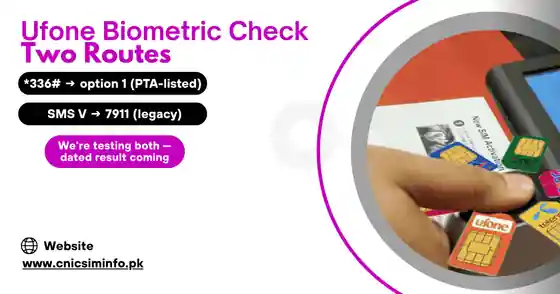
Whatever the network, the reply means the same thing. A positive response confirms your verification is complete. “Not Verified” means visit the franchise with your original CNIC and re-verify free, before the SIM risks suspension. Full per-network detail: the BVS guide.
Method 6
Method 6 — operator apps
Can you check in the app? Yes. Jazz World, My Zong, My Telenor, My Ufone and the ONIC app all show your number and registration status on the dashboard after login. You’ll need the number once to sign in, so run an own-number code first if you’ve forgotten it.
Apps are the comfortable middle ground for SIM owner details: more detail than an SMS, less hassle than a franchise visit. They’re also the only self-service route for ONIC, which runs app-only with no dial codes at all.
One habit to keep. Download operator apps only from the official Play Store or App Store listing. The fake “SIM checker” apps we cover later love to dress up as operator tools.
Method 7
Method 7 — helplines (identity-verified)
Can you call to check? Yes. Jazz 111, Zong 310, Telenor 345, Ufone 333, SCO 355. After identity questions, agents can confirm YOUR SIM owner details, flag unknowns and start blocks. They’ll never read out another person’s registration.
When you need help fast, the helpline is the quickest human in the loop. It’s the right first call when something urgent happens. Think of an unknown SIM you just found, a lost SIM that needs an instant block, or a signal that suddenly died.
Expect identity questions before anything is shared. That friction is the system working. And note what no agent will ever do, for anyone: reveal who a number belongs to. An agent who did would commit the same Section 16 offence as a lookup site.
Method 8
Method 8 — franchise (print · fix · transfer · disown)
Need a printed record or a fix? Go to the franchise with your original CNIC. After a fingerprint match, staff can print your full registration record, fix CNIC mismatches, transfer ownership, and process “SIM Disowning”. Changes reflect in your 668 or portal check within about 24 to 48 hours.
The franchise is where SIM owner details paperwork becomes action. It is also the only place a SIM ownership transfer happens: both parties, both original CNICs, one fingerprint each. Bring the original CNIC, because a photocopy won’t clear the fingerprint match. And learn the exact phrase for removing a SIM: ask for “SIM Disowning”, then keep the written reference number.
That 24-to-48-hour window matters too. Re-run your check two days after any franchise change. Only then judge whether the fix landed.
Method 9
Method 9 — 76367 network ID (exact format: N 03xx…)
Which network is a number on? SMS “N 03xxxxxxxxx” to 76367. The official portal documents the N prefix. It costs about Rs 2 plus tax and returns the CURRENT operator only, never a name. Essential after number porting, when prefixes lie.
Two details make this worth its own section in a SIM owner details guide. First, the format. The portal documents the leading N, and guides that say “just send the number” are passing along an untested version. Second, the reason it exists. Number portability (MNP) means a 0300 number may live on Zong today, so the prefix is a guess. 76367 is the answer.
Use it before calling any helpline about a number, so you call the operator that actually serves it today. It’s a network check, not a SIM owner details lookup. Full guide: 76367 network check.
Method 10
Method 10 — PTA channels (0800-55055 · CMS · portal)
How do you reach PTA about a SIM owner details problem? Three official routes, all free. Call the toll-free line 0800-55055, file at complaint.pta.gov.pk, or use the PTA CMS app. All three reach the regulator directly rather than your operator’s call centre. Keep every reference number PTA issues — it ties your case together across agencies.
PTA’s own channels are the level above the operators. Use them when a franchise won’t fix a SIM owner details problem, when you need an official dated record, or when you’re reporting an illegal data-selling site.
A complaint filed at the portal does two things at once. It directs the operator to act. And it timestamps your side of the story, which under the 365-day rule can matter more than the fix itself. Steps: the PTA complaint guide.
Method 11 · New PTA Tool
Method 11 — PTA Digital Assistant (WhatsApp 0315-0055055)
PTA on WhatsApp? Yes, since 26 February 2026. Save 0315-0055055, send any message, and a menu opens for SIM guidance, device (IMEI) checks and complaints. Verify the number on pta.gov.pk before saving it. A real PTA line never asks for an OTP or money.
The official name is the PTA Digital Assistant. It’s a menu-driven WhatsApp service, a fifth free front door to things PTA already ran: SIM owner details guidance, device verification, complaint filing. The shortcut wa.me/923150055055 opens the chat straight away.
Keep it in perspective, though. For the core question, how many SIMs sit on your CNIC, the primary SIM owner details routes are still 668 and the portal. The assistant adds convenience. And like every official channel, it deals only with your own identity and devices.
Method 12
Method 12 — NADRA identity channels (1777 · Pak-ID · 8400)
Identity-side checks? NADRA handles the CNIC behind every SIM owner details record. Call 1777 (or 051-111-786-100) for card problems, renew in the Pak-ID app — your CNIC number never changes on renewal — and SMS 8400 to track a NADRA application. One common mix-up worth knowing: 8300 is the ECP’s voter-information service, not a CNIC-status code.
Half of all SIM owner details trouble is really identity trouble, the kind you head off early by learning how to check your own CNIC details. An expired CNIC that threatens your SIMs. A lost card that becomes someone’s ghost-SIM chance. A renewal you’ve been putting off. That’s why NADRA’s channels earn the twelfth spot on this list.
And let’s clear up the code mix-up while we’re here. 8400 tracks NADRA applications. 8300 belongs to the Election Commission and reports voter information, not “CNIC status”, whatever some sites claim.
Which One?
Which method when? (decision matrix)
Which method is right for you? Full SIM owner details audit: 668 or the portal. SIM in hand: 667. A number’s network: 76367 with the N-format. Biometric: your BVS code. Print, fix or disown: the franchise. Abroad: the portal. Guidance or complaints: PTA’s lines and WhatsApp.
| Your situation | Use this | Cost |
|---|---|---|
| Full SIM owner details check, every SIM on my identity | 668 SMS or cnic.sims.pk | About Rs 2 / Free |
| I want activation dates too | cnic.sims.pk (the portal shows them) | Free |
| I’m holding a SIM. Is it mine, which network? | MNP to 667 | Standard SMS |
| Which network serves this number now? | N 03XXXXXXXXX to 76367 | About Rs 2 |
| Is my SIM biometrically verified? | BVS code (6001 / 7751 / V to 7911 / *336*1#) | Free or about Rs 1 |
| Forgot my own number | *99# / *8# / *8888# / *780*3# | Free |
| Printed record, a fix, transfer, or disowning | Franchise with original CNIC | Free (disowning up to Rs 200) |
| I live abroad | cnic.sims.pk (CNIC or NICOP) | Free |
| Complaint or guidance | PTA 0800-55055 · CMS app · WhatsApp 0315-0055055 | Free |
| CNIC expired, lost, or renewal due | NADRA 1777 · Pak-ID app · 8400 | Varies |
Every code in one table (bookmark this)
| Code / channel | What it does | How to use | Cost |
|---|---|---|---|
| 668 | All SIMs on YOUR CNIC (count) | SMS 13-digit CNIC, no dashes | About Rs 2 with tax |
| cnic.sims.pk | Same count plus activation dates, worldwide | Enter CNIC/NICOP + CAPTCHA | Free |
| 667 | The SIM in your hand (masked CNIC view) | Send “MNP” | Standard SMS |
| 76367 | A number’s current network | SMS “N 03xxxxxxxxx” | About Rs 2 with tax |
| 6001 / 7751 / 7911 / *336*1# | Biometric (BVS) status | Jazz CNIC to 6001 · Telenor CNIC to 7751 · Zong V to 7911 · Ufone *336*1# | Free or about Rs 1 |
| *#06# / 8484 | Show IMEI · check device (DIRBS) status | Dial · SMS the 15-digit IMEI | Free |
| 9000 | Report spam SMS or calls | Forward: number [space] message | Near-free |
| 3627 | Do Not Call Register | SMS “reg” or “unreg” (Telenor *3627#) | Standard SMS |
| Blocking | Phone-native block plus your operator’s app or helpline; report spam to 9000 | Settings / helpline | Free |
| 8400 / 8300 | NADRA application tracking · ECP voter info | SMS per format · SMS your CNIC | Standard SMS |
| ##002# | Cancel all hidden call/SMS forwarding | Dial once before bank-linking | Free |
| 0800-55055 / 0315-0055055 | PTA line · PTA Digital Assistant (WhatsApp) | Call · message | Free |
| 1799 / 1777 | NCCIA cyber helpline (24/7) · NADRA helpline | Call | Standard |
| 111 / 310 / 345 / 333 / 355 | Jazz · Zong · Telenor · Ufone · SCO helplines | Call | Standard |
Still unsure? The SIM owner details advisor at the top asks one question and points you to the right row.
668 or 667 — which one? Use 668 to see how many SIMs sit on your whole CNIC across every operator (SMS your CNIC, about Rs 2). Use 667 to check the one SIM in your hand right now (send MNP, standard SMS). 668 counts every SIM; 667 shows the masked identity and status of the SIM you are holding. In other words, the SIM owner CNIC link — which SIM sits on which identity — is what 668 counts. They answer two different questions, so pick by what you need.
Do It Now
Your first check — 60-second walkthrough
Never checked before? Do it right now. Open Messages. Type your 13-digit CNIC, no dashes. Send it to 668. Read your SIM owner details count for each operator. Screenshot the reply WITH the date. That dated SIM owner details screenshot becomes your baseline, and you’ll compare against it every month.
- Open the Messages app on any phone that holds your own SIM, even a basic keypad phone.
- Type your 13-digit CNIC with no dashes and no spaces, like 3520112345678.
- Send it to 668 and wait about 30 seconds for the operator-wise SIM count.
- Screenshot the reply with the date showing. That screenshot is your baseline.
- Compare the count to the SIMs you actually use. Any extra connection goes straight to the unknown-SIM action plan.
Any phone with your own SIM works. The SIM owner details check is tied to your CNIC, not to a smartphone, so a basic keypad phone is fine.
Reading the reply is simple. Put it next to what you actually use. One personal Jazz number and one work Zong number should read “Jazz: 1, Zong: 1”. If it does, save the screenshot and get on with your day.
But what if Jazz says 3 and you only ever bought one? Those extra connections are exactly what the unknown-SIM action plan exists for. Either way, your first check is the most valuable one you’ll ever run. It’s the baseline every later check gets measured against. Prefer a screen? Run the same audit at cnic.sims.pk and save the activation-dates view too. Full guide: check SIMs on your CNIC.
What to Expect
Anatomy of a 668 reply (real screenshot)
What does the reply look like? Searching “number of SIMs on my CNIC”? Your results arrive as one SMS listing each operator with a count. For example: “Jazz: 2, Zong: 1, Telenor: 0, Ufone: 1”. Some formats add masked numbers like 0300•••1234. Never full numbers, names or addresses.
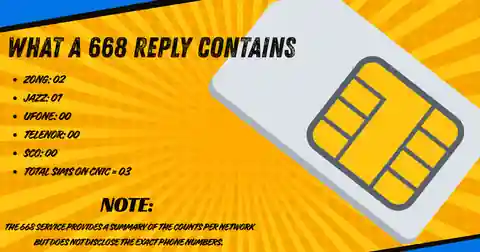
That bare-bones reply is the privacy feature scam sites pretend to beat. Even you, the CNIC holder, get only the count per network. A reply of “Telenor: 2” isn’t broken. It’s doing exactly what it was built to do.
Need to identify one specific SIM? That’s 667’s job. Is a count plain wrong? The franchise can pull the full record after a fingerprint match. Read the reply against your own memory, then file it away. A folder of dated screenshots is the cheapest legal evidence you’ll ever collect.
Avoid These
Common mistakes (and instant fixes)
Why did your SIM owner details check fail? Usually it’s one of five slips: dashes or spaces in the CNIC, or an old pre-renewal CNIC number breaking the SIM owner details query. It can also be expecting phone numbers in a count-only reply, typing your CNIC on a look-alike portal, or trusting a prefix after porting. Each has an instant fix.
- Dashes or spaces in the CNIC. 668 wants thirteen unbroken digits. One stray character breaks the check.
- Using an old CNIC number. After a NADRA reissue, always check with the CNIC you hold today.
- Expecting phone numbers in the reply. 668 returns a SIM owner details count by design. Use 667 to identify a specific SIM in your hand.
- Trusting a look-alike portal. Only cnic.sims.pk is official. Never type your CNIC anywhere else.
- Trusting a prefix after porting. Confirm any number’s live network with 76367 (N 03XXXXXXXXX), not the first four digits.
Roman-Urdu: Pehli dafa check karna ho to: Messages kholein, apna 13-hindsa CNIC (bina dash) likhein, 668 par bhejein, aur jawab parhein. Screenshot date ke saath save karein. Yahi aapka baseline hai.
Honest Answers
Can you check SIM owner details BY NUMBER? (honest answer)
By number — is it possible? No. No legal public tool in Pakistan shows a stranger’s name, CNIC or address from a phone number. You can check your OWN CNIC (668 or the portal) or the SIM in your own hand (667). That’s it. A stranger SIM owner details lookup is a Section 16 offence: up to 3 years in jail and/or a fine up to Rs 5 million.
This is the most-searched SIM owner details question in the country, so it deserves the plainest answer. Searches like “SIM information with number” or “SIM details by number” hit the same wall: the registry answers to a CNIC, never to a phone number. PTA’s registry has no public API and no public search window. Not for websites. Not for apps. Not for “premium” WhatsApp services. Adding “online” does not help either. “SIM information with number online” leads to the same dead end: the only official online check, cnic.sims.pk, opens with your own CNIC, never a phone number.
So any service that seems to know a stranger’s SIM owner details is doing one of two things: inventing the result, or recycling stolen breach data. And in both cases it’s harvesting every number and CNIC typed into it. This is exactly what PECA 2016 Section 16 prohibits — here’s the line in the law.
| What you enter | What you legally get back | Legal? |
|---|---|---|
| Your own 13-digit CNIC, via 668 or cnic.sims.pk | A per-operator count of every SIM on your CNIC, with activation dates on the portal | Yes, it’s your own record |
| The SIM in your own hand, MNP to 667 | That one SIM’s network and registration status, with a masked CNIC view | Yes, you hold the SIM |
| A stranger’s number, on any lookup site, app or WhatsApp service | Nothing real: fabricated or breach-recycled data, while your CNIC and number are harvested | No, a Section 16 offence |
| Provision | Offence | Maximum penalty |
|---|---|---|
| Section 3 | Unauthorized access to an information system or data | 3 months / Rs 50,000 / both |
| Section 4 | Unauthorized copying or transmission of data | 6 months / Rs 100,000 / both |
| Section 16 | Unauthorized use of identity information (the core “lookup” offence) | 3 years / Rs 5,000,000 / both |
| Section 17 | Unauthorized issuance of SIM cards | 3 years / Rs 500,000 / both |
The phrase doing the legal work is “without authorization”. You’re fully authorized for your own identity, which is why every method above is safe. You’re never authorised for a stranger’s. And the law reaches the user of a lookup service, not just its owner. These maximums come straight from PECA 2016, and the January 2025 amendment left Section 16 untouched. Ignore the “7 years plus Rs 5.7 million” penalty that floats around online. No such provision exists.
Straight Answer
Name & address from a number?
Can anyone get a name and address from a number? Only law enforcement, through a documented legal request to the operator. No website, no app, no “premium WhatsApp service” has that access. Every SIM owner details service that claims it is a scam collecting your CNIC.
The gap is total. An investigator on a registered case gets subscriber data through formal channels, with a paper trail and accountability at every step. A website with a search box has none of that. The moment it claims otherwise, you know what you’re looking at.
If you want a name because someone is harassing or defrauding you, skip to the route that actually works: the NCCIA section further down this page.
Myth vs Fact
What 667 actually returns
Does 667 show the owner’s name? No. It verifies the SIM in YOUR phone and returns three things: the network, the registration status, and a masked view of the CNIC it sits on. It never returns a name, an address, or the SIM owner details of a number you are not holding. It’s a verification code, not a reveal-anyone trick, whatever the “6-second” claims say.
Some sites dress 667 up as a SIM owner details loophole. The truth is narrower, and more useful. Send MNP to 667 from a SIM you hold, and the reply confirms that one SIM’s registration, masked CNIC included.
It can’t be pointed at anyone else’s number. That’s not a bug. It’s the design. Use 667 for what it’s genuinely good at: confirming a line is yours before you trust it with banking.
Clarified
Truecaller ≠ official record
Is Truecaller proof of ownership? No. It shows crowd-sourced labels pulled from other users’ contact books: nicknames, old owners, plain mistakes. Fine for screening spam calls. Never proof. The authoritative SIM owner details record is SVMS, and only you can read yours.
Truecaller has no link to PTA’s registry. When it names an unknown number, that name came from ordinary users who happened to save the number. A community phone book, not a government record.
The label could be a shop, a previous owner, a joke, or simply wrong. So screen your spam with it if you like. Just never cite it in a dispute, because only the SVMS record counts, and only official channels read it.
Myth Killed
The “NADRA can show anyone” myth
Can NADRA look up any number? No. NADRA verifies identity — the fingerprint match that lets an operator activate a SIM against your CNIC — and it publishes no search-by-number service to anyone. Any site advertising a “NADRA-powered” owner lookup is inventing its results, and searching a stranger that way is an offence under Section 16 of PECA 2016.
NADRA’s job in the SIM system is the front gate, not a directory. Its biometric system matches your fingerprint to your CNIC so an activation can be written into the registry. It issues ID documents. It doesn’t run a window where anyone can type a number and read a citizen’s record.
Sites borrowing NADRA’s name are trading on trust they don’t have. Treat the claim itself as the scam signal. That is also why the popular search “NADRA SIM owner details” has no official destination: the SIM-side checks belong to PTA (668 and cnic.sims.pk), while NADRA only proves who you are.
The Logic
Why lookup sites CANNOT be real (one-line logic)
Why can’t a site just show the owner? Because SVMS has no public API and no public search window, for anyone. So every “enter a number” SIM owner details site is either inventing results or laundering stolen data, while collecting what you type.
Hold onto that one line: “SVMS has no public API, for anyone.” It makes you immune to the whole category. There’s no partner tier, no paid access, no leaked developer key. The registry is a closed government system.
Everything a lookup site shows was faked to look real or recycled from an old breach. And the trade is never one-way. The CNIC or number you type in becomes part of the next dataset they sell.
The Honest Boundary
What law enforcement can do (that you can’t)
How do agencies trace numbers? Police and the NCCIA get subscriber and location data from operators under documented legal process, usually a registered case or court order. Being harassed? That’s your route: NCCIA 1799, not a lookup site.
This boundary is what keeps the SIM owner details system fair. The data exists, but only accountability opens it. An agency request is logged, tied to a case, and reviewable. The opposite of an anonymous search box.
So when someone is genuinely hurting you from an unknown number, don’t chase their identity yourself. Hand the problem to people with real legal authority. File at complaint.nccia.gov.pk or call 1799, attach your evidence, and let the process do what no website legally can.
Popular Searches
Popular phrasings, answered straight
“By CNIC / by NADRA / free / online / real”? By CNIC means your own SIM owner details, via 668 or the portal. Legal and easy. By NADRA: no such public service. Free: the portal. Online: the portal. “Real”: only SVMS, only for your own CNIC. Anything that starts from a stranger’s number is illegal.
SIM owner details by CNIC. The legitimate search. It just means checking your own CNIC via 668 or cnic.sims.pk. A count in about 30 seconds, for a couple of rupees at most.
SIM owner details online check. That’s cnic.sims.pk. Enter your 13-digit CNIC, pass the CAPTCHA, read the breakdown with activation dates. Official, and it works worldwide. More on the online check page.
SIM owner details by NADRA. No such public service exists. NADRA verifies identity behind the scenes. It runs no lookup window. People also type “NADRA SIM owner details” — same answer: use PTA’s own-CNIC checks instead.
Free SIM owner details. “Free” really means the portal, for your own CNIC. Anything offering free access to other people’s details is fake data or leaked data. Either way, a trap.
SIM information with number. With only a number, the single legal fact available is its current network, via 76367 in the N-format. Every fuller record, counts, names and dates, opens with a CNIC, and only for its own holder. Typing “SIM information with number online” changes nothing: the online door, cnic.sims.pk, still asks for your CNIC first.
Real SIM owner details. The only real record is PTA’s SVMS entry, and only your own is readable, through official channels. Sites promising “real” or “100% working” stranger lookups are advertising a crime. The full reframe lives at SIM owner details by number.
SIM owner details Pakistan. The country-wide phrasing, and its cousin “pak SIM owner details”. Every official route is Pakistani already: 668, cnic.sims.pk and 667 all read PTA’s national SVMS registry. Sites that bolt “Pak” onto their name to look official are not part of that system.
Check SIM details by CNIC. The wording shuffles — SIM information by CNIC, SIM CNIC number check, check SIM against CNIC — yet every version opens the same two doors: 668 by SMS or cnic.sims.pk online. One run covers all networks at once, because Jazz, Zong, Telenor, Ufone, SCO and ONIC all write to the same SVMS record.
SIM numbers by CNIC. A frequent hope, and a half-truth. The online check of SIMs on a CNIC returns per-operator counts and activation dates, never the full 11-digit numbers. To check number details by CNIC completely, take your original CNIC to the operator’s franchise. Codes count them; franchises can name them.
Spelling wobbles too: people also type it as “sim onwer detail”, “sim detalis” or “sim onfo”. The answer never moves — 668 or cnic.sims.pk, your own CNIC only.
Stay Safe
“Pak SIM Data” — what those sites really are
Is Pak SIM Data real? No. PTA’s registry has no public feed, so these sites show fabricated or breach-recycled records. While you read the fake result, they collect the CNIC you typed in. Some carry malware too. The real SIM owner details checks are 668, cnic.sims.pk and 667.
“Pak SIM Data” is a brand family, not a SIM owner details database. People land on these sites by googling “pak SIM owner details” or “SIM owner details Pakistan” — and reach the one kind of page that cannot deliver either. The sites and apps carrying the name promise a live window into the national registry. That window doesn’t exist, for anyone.
What they actually serve is a mix of invented records and stale leaked material, styled to pass a quick glance. And the business isn’t the “results”. It’s you. Every CNIC and number typed in gets harvested for the next dataset, and every visit feeds the ads and malware behind it.
The names change: “SIM database online”, “fresh SIM data 2026”, “live tracker”. The anatomy never does. The legal, near-free alternative takes 30 seconds: SMS your CNIC to 668, or open the free portal. The full breakdown lives at the Pak SIM Data truth page.
Is it illegal for me to just check? Yes, if the CNIC or number isn’t your own. Looking up a stranger on these sites is unauthorised access to identity information. That falls under PECA 2016 Section 16. The maximum is 3 years in prison, or a fine reaching Rs 5,000,000, or both. The law reaches the person who searches, not only the site owner.
The Breach Reality
“Fresh SIM data / database” — the breach reality
Where does “fresh data” come from? Old leaks. A Joint Investigation Team led by the FIA confirmed 2.7 million citizens’ records were stolen from NADRA offices between 2019 and 2023 (Dawn, March 2024). A records theft, not a live SIM owner details database hack. That’s what “database” sites resell, usually stale, often invented.
Understand the sourcing and the marketing falls apart. There has never been a documented live SIM owner details feed out of SVMS. What circulates is a patchwork of old incidents. There are the 2.7 million NADRA records the JIT confirmed. There is the April 2020 dark-web listing of 115 million mobile records, which officials disputed. And there are global password dumps, like the 184-million-credential database PKCERT warned about in May 2025.
“Fresh” is the one thing this material never is. Whoever sells it is moving stolen goods. Whoever searches it commits the same Section 16 offence. Sourced history: Pakistan’s documented data breaches.
Do Not Install
“Live tracker” — a trap, start to finish
Can an app track a SIM live? No legal public tracker exists. These apps steal your data or plant spyware, and they show a fake map pin for whoever you searched. Location data reaches law enforcement only, through legal process. Harassment? NCCIA 1799.
Location is the most protected data in the telecom stack, far beyond SIM owner details. It’s released to investigators under documented legal process, and to nobody else. An app store listing can’t change that. Neither can a Telegram channel.
What “live tracker” apps deliver is the reverse of the promise. They track you: contacts, messages, passwords. If someone’s location matters to your safety, that’s precisely the case the NCCIA exists for. More at the live tracker debunk.
Named Honestly
Brand-name “tools” (Minahil etc.)
Is “Minahil SIM Data” real? No. Brand-named lookup tools passed around social media are unlicensed recyclers of leaked data. They aren’t PTA services, and using them is unsafe and illegal. Your CNIC’s real SIM owner details live at 668 and the portal only.
Every few months a new name trends. A “tool” forwarded through WhatsApp groups and TikTok comments as if it were a public utility. The name changes. Nothing else does.
No licence exists for third-party SIM owner details access to SVMS. So a branded lookup is exactly as illegal as an unbranded one, with the same recycled data behind it and the same harvesting up front. We name the pattern without linking anything: if a tool’s pitch is “see anyone’s details”, the pitch itself is the confession.
Read the Listings
Play-Store apps & APKs — read their own confessions
Are SIM-owner apps safe? No. Their own listings admit to “publicly available” or “user-submitted” data. Reviews report WhatsApp payment scams. Several side-loaded SIM owner details APKs carried password-stealing malware. No PTA licence exists, so any “100% accurate” or “100% free” owner-lookup badge is marketing, not a fact. Use 668, the portal or 667, never an APK.
You don’t need an investigator here. The app pages confess in writing. Listings describe their sources as “publicly available data”, the polite phrase for scraped and leaked material. The one-star reviews tell the rest: payments demanded over WhatsApp for “premium” results that never come.
Off-store APKs are the darkest corner of the family. The NCCIA has banned lookup apps by name, and security advisories tie these download channels to malware that steals saved passwords. The safe amount of trust for a “SIM owner details” app is zero. Details: the app warning page.
The Real Cost
How scam data-sites actually harm you
What’s the harm in just trying one? Five kinds. Your CNIC joins the next SIM owner details dataset. You get fake or stale results. You risk malware. Section 16 reaches the USER of a lookup, not just its owner. And harvested numbers get hit with SIM-swap and OTP scams later.
- CNIC harvesting. The identity number you type in gets captured and resold. You came to check a leak and joined one.
- Fake or stale results. You pay, or sit through ads, for invented data.
- Malware. Off-store “checker” APKs have carried password stealers that empty far more than a wallet.
- Legal exposure. Section 16 covers the user of a lookup, not just the operator.
- Follow-on fraud. Harvested numbers get targeted with SIM-swap and OTP scams weeks later.
One Rule
The one-line immunity rule
One rule to stay safe? SVMS is closed. Anyone claiming a stranger’s details is faking it or breaking the law. Do the legal SIM owner details check instead: your CNIC through 668 or the portal, your SIM through 667, a number’s network through 76367.
Memorize that rule and the whole scam category loses its grip on you. Every future “new tool”, every rebrand, every viral forward gets measured against one sentence. And fails.
Enforcement keeps proving the point. In the year to June 2025 the PTA blocked 83 illegal SIM-sale sites. By September 2025 it reported 1,372 personal-data sites and apps blocked. In October 2025 the NCCIA dismantled 139 data-selling platforms. Sites built on the illegal promise vanish. The official self-checks of your own registration are still here.
No Panic — Recovery
Already typed your CNIC somewhere? Recovery steps
You used a lookup site — now what? Don’t panic. Change OTP-linked passwords. Switch to app-based two-factor codes. Run a dated 668 SIM owner details baseline today. Watch your SIM owner details count for new SIMs monthly. And report the site to PTA 0800-55055 and NCCIA 1799.
- Rotate the passwords that matter: bank, wallet, email, and anything that receives OTPs.
- Move two-factor codes off SMS. An authenticator app means a stolen number can’t harvest them.
- Run a dated 668 baseline today. Screenshot it. That’s your “before” picture.
- Re-check monthly. A new SIM appearing in your count is your signal to act, and you’ll catch it early.
- Report the site: PTA 0800-55055 or the complaint portal, plus NCCIA 1799. Takedowns really happen.
One visit to a bad site is an exposure, not a sentence. The damage model is slow, because harvested data gets packaged and resold over weeks. Acting today closes the window.
How Many?
How many SIMs on one CNIC? (5+3=8 — and who’s exempt)
What’s the limit? 8. Five voice SIMs plus three data SIMs, across ALL operators combined. The Supreme Court set it on 5 November 2015, and the SIM owner details registry enforces it at activation. Foreign nationals get 2 on a passport plus visa; POC holders get 2 on a valid POC. Companies register on an NTN, outside the personal cap. Not 25. Not 6. Not per-network.
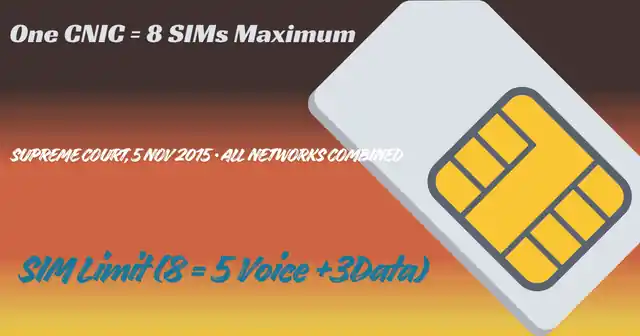
The cap is enforced where nobody can argue with it: at activation. The system simply won’t let a CNIC cross five voice or three data connections. That’s what makes a fake SIM visible. If your SIM owner details count sits at the limit and you didn’t buy that many, the gap is someone else’s SIM riding your identity.
The exemptions rarely get spelled out, so here they are. Foreign nationals: two SIMs on a passport with a valid visa. POC holders: two SIMs on a valid POC with passport, the SIM’s validity matching the POC. Children: none at all until 18, because a minor’s SIM sits on a guardian’s CNIC and counts towards that adult’s eight. Companies: connections registered against a National Tax Number, through the operator’s corporate desk. The check itself is identical for everyone. One 668 SMS or one portal visit reads your whole SIM owner details record. What happens over the cap? Right below.
Over the Cap?
Exceeding the limit — what actually happens
What if you’re over 8? New activations simply fail at the cap, and your SIM owner details count stays where it was. Unverified and excess SIMs get blocked in enforcement drives. If unknown SIMs pushed you over, disown them at the franchise and file a PTA complaint. The fee is waived for fraud cases.
Notice the precision here, because guides muddle it. The cap works at activation, through SVMS and NADRA. A ninth SIM gets refused before it exists. DIRBS plays no part in that. It governs devices.
What enforcement drives sweep up are SIMs that shouldn’t have survived: unverified biometrics, deceased-CNIC lines, expired-CNIC lines. If your count is over the cap and the extras aren’t yours, that’s your fraud evidence. Take it to the franchise, say “SIM Disowning”, and file the complaint the same day.
History
PTA SIM rules timeline (2012 to 2026, dated & sourced)
The current SIM owner details rules in one line? Cap of five voice plus three data per CNIC (Supreme Court, 2015). A 7-day wait before a second new SIM (January 2024). A Rs 200 ceiling on the disowning fee (January 2024). A 365-day disowning lock (late May 2026). And a midnight-to-6AM sales ban (19 May 2026).
| Date | Change | Source |
|---|---|---|
| 21 May 2012 | Per-CNIC SIM cap introduced (5) | Supreme Court order |
| 5 Nov 2015 | Five voice plus three data: 8 per CNIC, all operators combined | Supreme Court (CJ Anwar Zaheer Jamali); Express Tribune, 6 Nov 2015 |
| 1 Jan 2024 | Disowning fee capped at Rs 200 if held under 6 months; waived when the SIM was issued fraudulently | PTA notice |
| 24 Jan 2024 | 7-day NADRA wait before a second new SIM (first SIM, duplicates, transfers and MNP exempt) | PTA letter, 18 Jan 2024 |
| 3 Jun 2025 | NCCIA’s 24/7 cyber helpline 1799 launched (formerly the FIA 1991 line) | NCCIA |
| 20 Jan 2026 | NADRA facial-recognition certificate (Rs 20, valid 7 days) as a fingerprint-failure fallback | NADRA media release |
| 26 Feb 2026 | PTA Digital Assistant launched on WhatsApp: 0315-0055055 | pta.gov.pk |
| 10 Mar 2026 | Pakistan’s first 5G spectrum auction, about $507 million raised (Jazz, Ufone and Zong) | PTA / Profit / Geo |
| 8 Apr 2026 | Advisory: around 8.1 million SIMs on expired or renewal-due CNICs (about 4.5 million CNICs); roughly 1.5 million on deceased CNICs | Geo News / Express Tribune |
| 19 May 2026 | Nationwide midnight–6 AM new-SIM sales ban | ProPakistani / Profit |
| Late May 2026 | Disowning window for newly activated SIMs extended from 60 to 365 days | ARY News (24 May) · ProPakistani (25 May) · Geo Fact Check (PTA DG) |
| 1 Jul 2026 | Telenor Pakistan amalgamated into PTML (Ufone’s group) after IHC approval of 30 June; CCP had approved with conditions in October 2025 | IHC · CCP · Profit / Pakistan Today |
Not real, ignore these wherever you read them. There’s no June 2026 advisory of any kind. There’s no “Operation Clean Sweep 3.0”, no “limit reduced to 6”, and no “7-year / Rs 5.7 million penalty”. Those claims drift between unofficial sites. None appears in any PTA release or statute. The full set of viral claims gets verdicts on the SIM myths fact-check page, and the freshest changes are archived in the PTA SIM news changelog.
When did the 8-SIM-per-CNIC limit start?
The Supreme Court set the 8-SIM cap on 5 November 2015, under Chief Justice Anwar Zaheer Jamali. The cap is five voice SIMs plus three data SIMs, counted across all operators combined. Before that, a 5-SIM total cap applied from 21 May 2012. The cap has not changed since 2015, so any “2024 ruling” you read is wrong.
Are there new SIM rules in 2026?
Yes. 2026 added a midnight-to-6 AM new-SIM sales ban (19 May 2026) and a 365-day disowning lock on newly activated SIMs (late May 2026). PTA also advised users with expired CNICs to renew, warning that about 8.1 million SIMs risk blocking (8 April 2026). Your owner-details checks still work 24/7.
Did PTA block 4.9 million SIMs in a June 2026 advisory?
No. There was no June 2026 PTA advisory. The figure of 4,906,611 SIMs is a NADRA count announced on 17 June 2025, not a fresh 2026 blocking wave. Treat any site that dates it to June 2026, or claims a “limit reduced to 6”, as unreliable.
New in 2026
The 365-day rule — and the date fight, settled with proof
Can you disown a new SIM? Not for 365 days after activation. It used to be 60. PTA issued the advisory in late May 2026, and every SIM owner details guide had to catch up. ARY News reported it first, on 24 May 2026, and ProPakistani covered it on 25 May. PTA’s DG then confirmed it as true to Geo Fact Check. Wrongly registered? File the PTA complaint the same day.
A word on the date, because even careful sites disagree. Some print 24 May, others 25 May. The difference is simply who reported first and who followed. We give you the full chain above, and we’re archiving the primary coverage so you can check it yourself. That’s what settling a fact looks like.
The rule cuts both ways. Be careful whose SIM you approve with your fingerprint, because you’ll carry it for a year. And if a SIM was wrongly registered to you, the lock is exactly why the complaint can’t wait. Filing with PTA the same day creates the dated record that protects you while the removal grinds through. The portal’s activation-dates view shows where each SIM’s clock stands. Every dated rule sits in the timeline above.
Timing Rules
7-day wait & the midnight sales ban
The timing rules? A second (or later) NEW SIM needs a 7-day NADRA wait, since 24 January 2024. Your first SIM, duplicates, transfers and porting are exempt. And since 19 May 2026, new-SIM sales are banned nationwide from midnight to 6 AM. Your SIM owner details checks work 24/7.
Both rules exist for one reason: slowing down bulk SIM fraud. The 7-day wait kills the “walk in, walk out with five SIMs” trick. The night ban removes the hours when oversight is thinnest.
Neither touches your SIM owner details checks. 668, the portal and every code on this page work at any hour. And neither applies to replacements, transfers or porting. New-SIM timing details: the waiting period page.
Plainly Put
Your SIM is your legal identity — liability, plainly
Are you responsible for SIMs on your CNIC? Yes. Every SIM in your SIM owner details record is legally yours, and fraud on any of them traces to you first. That’s the whole case for a 2-minute monthly check: catch and disown before someone’s crime becomes your file.
This is the sentence that turns a curiosity into a habit. A SIM registered on your CNIC is, in every investigator’s eyes, your line. Whoever actually carries it.
If it sends the scam texts or receives the fraud OTPs, the first door knocked on is yours. Your defence is a dated paper trail. Monthly SIM owner details screenshots show when the SIM appeared. The complaint you filed on the day you found it does the rest. Two minutes a month is cheap insurance.
Why Monthly
12 sourced reasons to check monthly
Why check your SIM owner details monthly? OTP and wallet theft. Legal liability. The 365-day lock, so catch it early. SIM-swap. Ghost SIMs. Biometric-expiry blocks. Cap breaches. Expired-CNIC risk (8.1 million flagged). Deceased-CNIC misuse. Breach exposure. Dormant recycling. And dated evidence.
- OTP and wallet theft. An unknown SIM on your CNIC can quietly receive your banking codes.
- Legal liability. Anything done on a SIM in your name lands at your door first.
- The 365-day lock. Since a PTA advisory on 24 May 2026, a new SIM can’t be disowned or transferred for a full year. Finding it early matters more than ever.
- SIM-swap fraud. Early detection stops a number takeover before accounts drain.
- Ghost SIMs. Franchise-level fraud can register SIMs without your knowledge.
- Biometric-expiry blocks. An unverified SIM can be suspended. A check warns you first.
- Cap breaches. SIMs you didn’t activate push you over the 8 limit.
- Expired-CNIC risk. Around 8.1 million SIMs sit on renewal-due CNICs (April 2026 advisory). Yours shouldn’t be among them.
- Deceased-CNIC misuse. An unattended family record is a known fraud route. 3.2 million such SIMs were blocked in one enforcement year.
- Breach exposure. A Joint Investigation Team confirmed that 2.7 million citizens’ records were compromised between 2019 and 2023 (Dawn, March 2024). Leaked CNIC data gets used to register SIMs. So it’s worth checking whether your CNIC turned up in a known data breach. Monitoring is the one defence a leak can’t beat.
- Dormant recycling. 891,000 dormant SIMs were blocked or recycled in one enforcement year (ProPakistani, 2 January 2026). Never leave banking tied to a number you stopped using.
- Dated evidence. A monthly 668 screenshot is a timestamped record if you ever must prove a SIM wasn’t yours.
Verified 2026
Pakistan SIM-verification at a glance (verified 2026)
How big is the system? Pakistan had 208,057,255 active cellular subscribers in June 2026, per PTA telecom indicators, every one of them a SIM owner details record in SVMS, up from 206,008,479 in May. Jazz leads on 75,421,212, then Zong 55,600,136, Telenor 44,046,436, Ufone 30,810,942 and SCO 2,178,529. June 2026 is the last month PTA lists Telenor on its own line: the PTCL–Telenor merger completed on 1 July 2026.
| Enforcement figure | Count | Source |
|---|---|---|
| SIMs blocked on deceased CNICs | 3.2 million+ | ProPakistani, 2 Jan 2026 |
| SIMs on expired CNICs blocked | 783,000 (360,717 CNICs) | ProPakistani / Express Tribune |
| Dormant SIMs blocked or recycled | 891,000 | ProPakistani, 2 Jan 2026 |
| Illegal SIM-sale websites blocked | 83 | ProPakistani, 2 Jan 2026 |
| Personal-data sites/apps/pages blocked | 1,372 | Express Tribune / PTA, 9 Sep 2025 |
| Data-selling platforms dismantled (NCCIA) | 139 | Pakistan Today / Express Tribune, 2 Oct 2025 |
| Raids against SIM fraud | 44 local (71 arrests, 5,300+ SIMs) · 32 international (46 arrests) | ProPakistani, 2 Jan 2026 |
Why do market numbers belong on a SIM registration page? Because scale is the argument. With 200+ million active SIMs and millions blocked in a single year, “it won’t happen to my CNIC” isn’t a plan. Be the person with dated SIM owner details screenshots. All verified figures, with sources, live on the Pakistan SIM statistics page.
Take Action
Found an unknown SIM? The 6-step plan
Unknown SIM — what now? Six steps. Screenshot the SIM owner details result with the date. Block it through the helpline. Disown it at the franchise with your original CNIC. File a PTA complaint. Secure your bank and wallet accounts. Re-check in 24 to 48 hours.
- Document it. Screenshot the 668 or portal SIM owner details result with the date showing, plus the activation-dates view if you can.
- Flag it fast. Call the operator’s helpline (Jazz 111, Zong 310, Telenor 345, Ufone 333, SCO 355) for an emergency block.
- Disown it in person. At the franchise, with your original CNIC and a fingerprint, say the exact words “SIM Disowning”. Keep the written reference number.
- File the PTA complaint at complaint.pta.gov.pk or 0800-55055, attaching your dated screenshot and the franchise reference number. That’s your dated official record.
- Secure what’s downstream. Change bank, wallet and email passwords, and move OTPs to an authenticator app.
- Re-check after 24 to 48 hours and confirm the SIM count has dropped.
Expect two realities on the way. The fee: up to Rs 200 if the SIM was held under six months. It’s waived entirely when the SIM was issued fraudulently without your consent (PTA, 1 January 2024). The timing: if the rogue SIM is recent, the 365-day lock may delay the formal transfer. File the complaint anyway, the same day. The dated record is what proves the SIM was never yours. Full hub: unknown SIM on CNIC.
Roman-Urdu: Agar koi anjaan SIM mile to pehle screenshot lein. Phir operator helpline par block karwayein. Franchise mein original CNIC ke saath biometric “SIM Disowning” karwayein, aur PTA complaint zaroor darj karein.
Fee · Proof · Timing
Block & disown — fee, proof, timing
What does disowning cost? Up to Rs 200 if the SIM was held under six months on your SIM owner details record. Free when it was issued fraudulently (PTA, 1 January 2024). It happens in person, with your original CNIC and a fingerprint. The 365-day lock may slow a transfer, but never your dated complaint.
Three pieces of paper decide how smoothly this goes. The original CNIC, because photocopies fail the fingerprint match. The written reference number from the franchise, so ask for it. And the PTA complaint number, your timestamp.
With those three, even a delayed removal settles in your favor. Without them, it’s your word against a registry entry. Steps and fees: block and disown guide.
Housekeeping
Deactivate an extra SIM you DO own
Too many of your own SIMs? Pick the keepers after a fresh SIM owner details check. Move any bank, wallet or two-factor setup off the extras. Then deactivate the rest at the franchise with a fingerprint. Re-run your 668 SIM owner details check after 48 hours to confirm the count dropped.
The order matters more than the trip: migrate first, deactivate second. A SIM that still receives a wallet’s OTPs isn’t “spare”. It’s a loose key to your money.
Walk through each extra number’s attachments: bank alerts, JazzCash or Easypaisa, WhatsApp, app logins. Re-point them at your keeper number. Only then let the franchise retire the line. Remember the recycling stat above. Numbers you abandon eventually belong to someone else. Guide: deactivate an extra SIM.
Report
Filing a PTA complaint (that actually moves)
How do you file with PTA? File at complaint.pta.gov.pk, call the toll-free line 0800-55055, or use the PTA CMS app. Include your CNIC, the operator’s name, the SIM in question, a dated 668 or portal screenshot, and one plain sentence saying what you want fixed in your SIM owner details record. Complaints are free — PTA never asks for a fee. Save the reference number.
A complaint that moves is a complaint with evidence attached. Lead with the dated screenshot. Name the operator and the count. Say what the franchise did or wouldn’t do. Then state plainly what you want: “remove the SIM activated on [date] that I never authorised”.
The reference number you get back is the thread that ties your case together across PTA, the operator and, if needed, the NCCIA. For cybercrime, the next section covers the NCCIA route.
Cybercrime
NCCIA cybercrime complaint (1799 · since Jun 2025)
Fraud or harassment — where do you go? The NCCIA, whose 1799 cybercrime helpline has run since 3 June 2025. File at complaint.nccia.gov.pk or call the 24/7 cyber helpline 1799, live since 3 June 2025. Keep your evidence, your SIM owner details screenshots and your PTA reference.
The National Cyber Crime Investigation Agency took over from the FIA’s cybercrime wing, and its 1799 helpline replaced the old FIA-era line. Pages still pushing only the old FIA numbers are out of date.
Use the NCCIA for what it’s built for: identity theft, SIM-based fraud, harassment from unknown numbers, and reporting data-selling sites. The helpline guides you and helps lock down compromised accounts. The formal complaint goes through the portal, with your CNIC, your evidence, and any PTA reference attached. Guide: NCCIA complaint steps.
Recoverable?
Reactivate a blocked SIM (windows vary by operator)
Blocked SIM — can you get it back? Usually yes if you act promptly — exact windows vary by operator, so call the helpline first, through fingerprint re-verification at the franchise with your original CNIC. After long inactivity the number may be recycled to someone else. So never leave banking on a dormant number.
A block is a pause with a countdown, not a death sentence. Inside the window, one franchise visit usually restores the line.
Past it, the number goes back into the pool. And whoever gets it next inherits whatever you left attached: wallet alerts, account-recovery texts, WhatsApp registration. If a number matters, keep it alive. If it doesn’t, retire it properly using the steps above. Details: reactivate a blocked SIM.
Protect Yourself
SIM-swap & OTP fraud — the working defence
How do you beat SIM-swap? Six habits. A monthly 668 SIM owner details audit. App-based two-factor codes instead of SMS. A SIM PIN plus a WhatsApp two-step PIN. Never share any OTP. Low transaction limits. And treat sudden “no service” as an emergency: call your operator from another phone right away.
SIM-swap works by moving your number onto a criminal’s SIM, usually through a CNIC photocopy and a careless “duplicate SIM” request. From that moment, they receive your banking OTPs.
The tell is sudden, unexplained loss of signal. A number can only live on one SIM at a time, so when a duplicate activates, your phone shows “no service”. Accounts have been drained within minutes of a swap. That’s why the layered defence matters: an authenticator app means a stolen number can’t harvest your codes, and low limits cap whatever slips through.
If your signal vanishes for no reason, act in this order from another phone:
- Block the line. Ask your operator to suspend the number at once: Jazz 111, Zong 310, Telenor 345, Ufone 333. After identity questions, the block is usually instant.
- Freeze the money. Call your bank or wallet on the number printed on your card and stop online access. This is the step that saves the balance.
- Disown and replace. Take your original CNIC to the franchise, ask for “SIM Disowning” (fingerprint required), and get a verified replacement so you keep the number.
- Report it. File with the NCCIA cyber helpline 1799 or complaint.nccia.gov.pk, and keep every reference number as evidence.
Fold these habits into the monthly self-check routine below and the attack loses its economics. A swapped number that yields no OTPs isn’t worth the fraudster’s paperwork. More on this: SIM-swap fraud.
Stay Alert
Six scams running right now
Which scams are active? Six, right now. Fake “SIM will be blocked” texts. OTP-sharing calls. Spoofed bank caller-ID. Fake PTA or NADRA “fees”. Fake FBR or BISP refunds. And roadside fingerprint theft. Each of the six has a one-line defence on this page, and one habit stops most of them: never read an OTP aloud, and verify any SIM warning only at cnic.sims.pk or PTA’s 0800-55055.
- “Your SIM will be blocked” texts. They ride on the real expired-CNIC drive. Verify only at cnic.sims.pk. Never tap the link, never pay.
- OTP-sharing calls. “Your bank” asks you to read out a code. No real institution ever asks for an OTP.
- Spoofed caller-ID. The call can show your bank’s real number. Hang up and dial the number printed on your card yourself.
- Fake PTA or NADRA fee demands. Official complaints are free. Nobody calls asking for money to “keep your SIM active”.
- Fake FBR or BISP messages. A refund that needs your CNIC plus an OTP is phishing. Use the official IRIS and BISP channels only.
- Roadside fingerprint theft. An “agent” takes an extra thumb impression and registers SIMs on your CNIC. Give biometrics at official franchises only.
Report spam to 9000 (forward the sender’s number, a space, then the message — that’s the right code, not “7622”). Stop marketing messages with “reg” to 3627. Block a nuisance number from your phone’s own settings or the operator app. Report fraud to PTA 0800-55055 and NCCIA 1799. All six patterns, expanded: SIM scams in Pakistan. And fold these defences into the 10-minute monthly SIM checklist.
10 Minutes
Monthly 10-minute security checklist
What’s the routine? Run the 668 SIM owner details check or open the portal, and screenshot it with the date. Compare with last month. Send MNP to 667 from each SIM you hold. Check BVS status. Report any spam to 9000. Confirm your app-based two-factor codes. Archive the screenshots.
- Audit. Run the 668 SIM owner details check or open cnic.sims.pk. Screenshot with the date, plus the activation-dates view.
- Compare. Set it against last month’s screenshot. Investigate any increase the same day.
- Verify. Send MNP to 667 from each SIM you physically hold.
- Biometric. Confirm BVS status (Jazz 6001, Telenor 7751, Zong V to 7911, Ufone *336*1#).
- Harden. App-based two-factor codes on financial accounts. Low transaction limits. SIM PIN on.
- Archive. Keep the dated screenshots in one folder. That’s your evidence trail.
Ten minutes a month covers your identity, your wallet and your legal record. A printable one-page PDF version is on the way.
Before You Link
Before linking a SIM to bank/wallet
The pre-linking checks? Two codes. Send MNP to 667 to confirm its SIM owner details show it registered to you. Then dial ##002# once to cancel any hidden call or SMS forwarding. Only then attach JazzCash, Easypaisa or a bank account.
Taking over a new or second-hand number deserves two minutes of care. The 667 reply, with its masked CNIC view, proves the line sits on your identity and not a previous owner’s.
The ##002# dial is the lesser-known half. It cancels every call and SMS forwarding rule on the line in one go. That closes the classic silent-fraud setup, where your OTPs quietly copy themselves to an attacker’s phone. Two codes, then link your money. Full checklist: before you link a SIM to a bank.
Act Today
Lost CNIC? Same-day protocol
CNIC lost — what happens in the first 24 hours? Report it to NADRA (1777) and file a police FIR the same day. Run a dated 668 SIM owner details baseline. Apply for a replacement in the Pak-ID app. Change OTP-linked passwords. Then check monthly.
Speed is the whole defence here. A lost card, or even a photocopy that wandered off, is the raw material for a fake registration. And the 365-day lock now makes each ghost SIM a year-long headache.
The same-day FIR and NADRA report put your loss on record before any SIM appears. The dated 668 SIM owner details baseline proves what your CNIC looked like at the moment of loss. Everything found after that line is provably not yours — and the week-one play for such a line is the unauthorised-SIM action plan. Full protocol: lost CNIC and SIM risk.
From Abroad
Overseas Pakistanis & NICOP/POC holders
Checking from abroad? cnic.sims.pk serves your SIM owner details from any country with a CNIC or NICOP. No Pakistani SIM needed. To disown from abroad, authorise a trusted person in Pakistan with a notarized authority letter and a copy of your CNIC, because disowning itself needs a fingerprint, in person.
Distance changes the tools, not your rights. The portal is built for you: CNIC or NICOP, any country, no VPN, activation dates included. That makes the monthly SIM owner details routine fully workable from Toronto or Riyadh.
The one step that needs a body in Pakistan is disowning, because the fingerprint is the signature. Hence the notarized letter for a family member you trust. And keep your NADRA documents current from abroad too. An expired card threatens SIMs no matter where their owner lives. Full guide: overseas and NICOP SIM check.
Family Duty
A deceased relative’s SIMs (act within 30 days)
After a death in the family? Take the death certificate, the deceased’s CNIC, your CNIC and a NADRA Family Registration Certificate (FRC) to each operator’s franchise. Block, transfer or disown the SIMs so the SIM owner details record closes cleanly. Then cancel the CNIC at NADRA. Move fast: 3.2 million deceased-CNIC SIMs were blocked in one enforcement year.
It’s a hard errand at a hard time. That’s exactly why criminals count on it being postponed. An unattended record is a ready-made identity, and the April 2026 advisory still flagged roughly 1.5 million SIMs sitting on deceased CNICs.
Treat the franchise visits as part of settling the estate, within about 30 days. Close the identity itself at NADRA when the connections are done. Steps and documents: a deceased person’s SIMs.
Quick Cards
Minors · transfers · foreigners · expired CNIC (quick cards)
The special SIM owner details cases? Under-18: the SIM sits on a guardian’s CNIC and counts towards their 8 (full rules for a minor’s SIM). Transfers: both people at the franchise, fingerprints, with the 365-day lock on new SIMs. Foreigners and tourists: 2 SIMs on a passport plus visa. Expired CNIC: renew via Pak-ID, NADRA or e-Sahulat, your number never changes.
No SIM on a B-Form. A child’s line registers on a parent’s or guardian’s CNIC, and it counts towards that adult’s eight. The line transfers at a franchise once the child gets their own CNIC. More: SIMs for minors.
Both parties visit the franchise together with original CNICs. The new owner gives a fingerprint. Note: a freshly activated SIM can’t transfer until the 365-day lock expires. More: SIM ownership transfer.
Up to two SIMs against a passport with a valid visa (or a POC), at an operator’s official service centre, not a roadside stall. Validity ties to the stay. More: tourist SIMs.
Around 8.1 million SIMs sit on renewal-due CNICs (8 April 2026 advisory) and risk suspension. Renew via the Pak-ID app, a NADRA centre or e-Sahulat. Your 13-digit number stays the same. Then re-run your 668 SIM owner details check. More: expired CNIC and SIMs.
By Network
Per-operator panel + the PTCL–Telenor merger (1 Jul 2026)
What’s the per-network picture? One 668 reply covers your SIM owner details on all networks. Per-network codes: Jazz *99# / 6001. Zong *8# / V to 7911. Telenor *8888# / 7751. Ufone *780*3# / *336*1# (see Method 5). SCO 355. Wondering how to check Telenor SIM owner name, or any single operator’s? The route never changes — 668 or the portal for your own CNIC only. Every network’s own-number code sits on one master sheet. ONIC app (0339, 0371–79). And Telenor merged into PTML, Ufone’s group, on 1 July 2026.
| Network | Own number | Biometric (BVS) | Helpline | Prefixes |
|---|---|---|---|---|
| Jazz / Warid | *99# | SMS CNIC to 6001 | 111 | 0300–0309 · 0320–0329 (ex-Warid) |
| Zong (CMPak) | *8# | Send V to 7911 | 310 | 0310–0319 · 0360–0369 |
| Telenor (PTML group) | *8888# | SMS CNIC to 7751 | 345 | 0340–0349 |
| Ufone (PTML) | *780*3# (alt *1#) | *336*1# (see Method 5) | 333 | 0330–0338 |
| SCO / SCOM (AJK & GB) | Franchise / app | Franchise | 355 | 0355–0357 |
| ONIC (digital brand on Ufone) | ONIC app | App | App / onic.pk | 0339 · 0371–0379 |
One prefix range trips almost everyone: 0320 to 0329 was Warid and is now Jazz, though people assume it’s Zong. And after porting, any prefix is only a guess. A 0300 number may live on Zong today. For any live number, skip the guessing and send N 03XXXXXXXXX to 76367.
Want the full walkthrough for your own network? Each guide covers the own-number USSD, the app login and the biometric check, step by step. Start with the Jazz number check code, the Zong number check code or the Telenor number check code. Ufone’s code is *336*1#.
Whichever brand serves you, nothing changes for you as a subscriber. Your number, your SIM and your registration all stay the same. So does the registry behind your SIM owner details. One 668 reply still covers every operator. Merger updates, as they land: the merger tracker.
Device Side
eSIM & the device side (IMEI · DIRBS · lost phones)
eSIM and devices — how do they fit in? Jazz, Zong and Ufone sell consumer eSIMs, and each lands in your SIM owner details count like any plastic SIM. ONIC is app-native, and Telenor offers eSIM at select outlets (re-check after the merger). Same fingerprint step, same 8-SIM cap, same visibility in your 668 SIM owner details count. For devices: dial *#06# for the IMEI, SMS it to 8484 for its DIRBS status, which reads Compliant or not.
Keep the two systems straight and everything clicks. SVMS ties a SIM to a CNIC. Every SIM card registered against your CNIC sits in that record. That’s what 668 reads. DIRBS ties a handset to its IMEI and decides whether that device may use Pakistani networks at all.
An eSIM changes nothing about your SIM owner details. Same fingerprint registration, same cap, same spot in your count. You scan a QR code instead of pushing in plastic. Your phone must support eSIM and be DIRBS-compliant, which one *#06# dial and one 8484 SMS confirm. Guide: eSIM in Pakistan.
Lost or stolen phone? File a police FIR first. Then lodge a blocking request on PTA’s Lost & Stolen Device System with the IMEI. The handset gets blocked across all networks, usually within about 24 hours, and can be unblocked if you recover it. PTA blocks. The police trace. Write your IMEI down today, before you ever need it. And buying second-hand? The handset and the SIM are separate. Check the device via *#06# plus 8484, and never keep using the previous owner’s SIM. Steps: block a lost or stolen phone.
What the 8484 reply tells you. DIRBS answers with a status. Compliant means the device is approved and works on every Pakistani network. Non-compliant means it is unregistered or the import tax is unpaid, so service stops until you clear it. Blocked means the IMEI was reported lost, stolen or barred, so never buy that phone. You can run the same free check at PTA’s DVS portal (dirbs.pta.gov.pk) or the Device Verification System app, not only by SMS. Dual-SIM phones, including a physical SIM plus an eSIM, carry two IMEIs, so check both.
Roman-Urdu + اردو
Roman-Urdu + اردو — mukammal khulasa
Urdu mein? SIM owner details check karne ke liye apna 13-hindsa CNIC (bina dash) 668 par SMS karein (taqreeban Rs 2), ya cnic.sims.pk kholein — bilkul free. Har network ki SIMs ka count aa jayega. Haath wali SIM ke liye MNP likh kar 667 par bhejein. Hadd: 8 (5 voice + 3 data). Ajnabi ka number check karna PECA 2016 ke tehat jurm hai.
Kitni SIMs ho sakti hain? Ek CNIC par maximum 8: paanch voice aur teen data SIMs, tamam networks mila kar (Supreme Court, 5 November 2015). Na 25, na 6. Sirf 8. Foreigners ke liye 2 (passport + visa par).
Anjaan SIM mile to? Pehle screenshot lein (date ke saath). Phir operator ki helpline (Jazz 111 · Zong 310 · Telenor 345 · Ufone 333 · SCO 355) par block karwayein. Uske baad franchise mein original CNIC ke saath biometric “SIM Disowning” karwayein. Aur PTA complaint (0800-55055 / complaint.pta.gov.pk) zaroor darj karein. Yaad rahe: late May 2026 ki advisory ke baad nayi SIM 365 din tak disown nahi ho sakti. Is liye complaint fauran karein taake dated record ban jaye.
Kya cheezein nahi karni? Kisi “SIM owner details by number” site par ajnabi ka number na dalein (illegal). Kisi paid “Pak SIM Data” ya WhatsApp wali service ka istemal na karein. Apni SIM ya CNIC copy kisi ko na dein. Spam report karne ke liye number aur message 9000 par forward karein. Apna number bhoolne par: Jazz *99# · Zong *8# · Telenor *8888# · Ufone *780*3#. Mahine mein ek baar 668 SIM check — sab se sasti hifazat.
اردو میں فوری رہنمائی: اپنا 13 ہندسوں کا شناختی کارڈ نمبر (بغیر ڈیش کے) لکھ کر 668 پر ایس ایم ایس کریں، یا مفت سرکاری پورٹل cnic.sims.pk کھولیں — تقریباً 30 سیکنڈ میں ہر نیٹ ورک پر رجسٹرڈ سمز کی تعداد مل جائے گی۔ ایک شناختی کارڈ پر زیادہ سے زیادہ 8 سمز (پانچ وائس + تین ڈیٹا) ہو سکتی ہیں — سپریم کورٹ کا فیصلہ، 5 نومبر 2015۔ انجان سم ملے تو تاریخ کے ساتھ اسکرین شاٹ لیں، آپریٹر کی ہیلپ لائن پر بلاک کروائیں، فرنچائز پر اصل شناختی کارڈ کے ساتھ بائیومیٹرک “سم ڈس اوننگ” کروائیں اور پی ٹی اے میں شکایت درج کریں (0800-55055)۔ خبردار: کسی بھی “پاک سم ڈیٹا” یا “لائیو ٹریکر” ویب سائٹ پر اجنبی کا نمبر نہ ڈالیں — یہ پیکا 2016 کے تحت جرم ہے اور آپ کا ڈیٹا چوری ہونے کا خطرہ بھی۔
اردو میں عام سوالات
کیا نمبر سے سم کے مالک کا نام معلوم ہو سکتا ہے؟
نہیں۔ پاکستان میں کوئی قانونی عوامی طریقہ نہیں جو کسی اجنبی کا نام، شناختی کارڈ یا پتہ اس کے نمبر سے دکھائے۔ آپ صرف اپنے شناختی کارڈ کی سمز 668 یا cnic.sims.pk پر، اور اپنے ہاتھ والی سم 667 پر چیک کر سکتے ہیں۔ کسی اجنبی کا نمبر چیک کرنا پیکا 2016 کی دفعہ 16 کے تحت جرم ہے۔
667 پر MNP بھیجنے سے کیا معلوم ہوتا ہے؟
667 پر MNP بھیجنے سے صرف آپ کی اپنی ہاتھ والی سم کی تصدیق ہوتی ہے: اس کا نیٹ ورک، رجسٹریشن اسٹیٹس، اور شناختی کارڈ کی جزوی (خفیہ) جھلک۔ یہ کسی دوسرے شخص کا نام یا مکمل شناختی کارڈ نہیں دکھاتا۔ “667 سے کسی کا نام معلوم ہو جاتا ہے” والی بات غلط ہے۔
نئی سم کب تک ڈس اون نہیں ہو سکتی؟
نئی ایکٹیویٹ ہونے والی سم 365 دن تک ڈس اون یا ٹرانسفر نہیں ہو سکتی (پہلے یہ مدت 60 دن تھی)۔ پی ٹی اے کی ایڈوائزری مئی 2026 کے آخر میں آئی۔ اس لیے اگر آپ کے نام پر غلط سم نکلے تو اسی دن پی ٹی اے شکایت 0800-55055 پر درج کرائیں تاکہ تاریخ کے ساتھ ریکارڈ بن جائے۔
Poori Urdu guide alag URL par jald aa rahi hai — 668, portal, by-number, limit aur block guides, Urdu script mein.
کیا موبائل نمبر سے سم مالک کا نام معلوم ہو سکتا ہے؟ نہیں۔ پاکستان میں کوئی قانونی ویب سائٹ یا ایپ کسی اجنبی کے نمبر سے نام، شناختی کارڈ یا پتہ نہیں دکھا سکتی۔ یہ پیکا 2016 کی دفعہ 16 کے تحت جرم ہے۔ آپ صرف اپنے شناختی کارڈ کی سمز (668 یا cnic.sims.pk) یا اپنے ہاتھ میں موجود سم (667) چیک کر سکتے ہیں۔
ایک شناختی کارڈ پر زیادہ سے زیادہ کتنی سمز؟ صرف 8: پانچ وائس اور تین ڈیٹا سمز، تمام نیٹ ورکس ملا کر (سپریم کورٹ کا فیصلہ، 5 نومبر 2015)۔ نہ 5، نہ 6، نہ 25۔ غیر ملکیوں کے لیے 2 (پاسپورٹ اور ویزا پر)۔ مہینے میں ایک بار 668 سے اپنی سمز چیک کریں۔
Questions
FAQ hub · sources · author (final trust block)
Where’s everything else? Right here. 40 real SIM owner details questions in three sets: methods, legal and limits, problems and safety. Then the full sources list and the author card. Every answer runs 40 to 60 words and follows the same fact rules as the rest of this page.
Set 1 — Checking & methods
How do I check SIM owner details in Pakistan?
Text your 13-digit CNIC (no dashes) to 668, or enter it at cnic.sims.pk. PTA replies with your SIM owner details: a count of every SIM on your CNIC, per operator. The portal is free; the SMS costs about Rs 2. No site can legally show a stranger’s details.
How many SIMs are on my CNIC?
Send your CNIC to 668 or check cnic.sims.pk for the exact per-operator SIM owner details count. The legal maximum is 8: five voice plus three data SIMs, across all operators combined, set by the Supreme Court on 5 November 2015.
Is the 668 SIM owner details check free?
No. Each 668 SMS costs about Rs 2 with tax. The genuinely no-cost option is PTA’s cnic.sims.pk portal. It runs the same SIM owner details check, shows activation dates, and works from outside Pakistan too. The portal needs no VPN and no app for your SIM owner details, just your CNIC or NICOP.
Is “free SIM owner details” real or a scam?
The official check really is free — that is the point. cnic.sims.pk charges nothing, works worldwide and shows activation dates; the 668 SMS costs about Rs 2. Scam pages use “free SIM owner details” to promise strangers’ records instead. Those results are fabricated or recycled breach data, and the site keeps whatever CNIC you type in.
What is 667 used for?
667 is PTA’s SIM owner details verification code for the SIM physically in your phone. Send MNP to 667 from that SIM to confirm its network and status, with a masked CNIC view. It can’t look up other people’s SIMs or names.
What’s the difference between 668 and 667?
668 takes your CNIC and counts every SIM owner details entry registered on it, across all networks. 667 takes “MNP” from the SIM in your hand and confirms that one SIM’s registration. Run the full SIM owner details audit with 668. Verify a specific SIM with 667.
How do I find my own mobile number for free?
Dial your network’s code, even on zero balance: Jazz *99#, Zong *8#, Telenor *8888#, Ufone *780*3# (alternate *1#). Your number appears on screen. If a code fails, use the operator’s app or send MNP to 667. Only Jazz’s *99# is documented by the operator itself. The other three are community-standard codes.
What is cnic.sims.pk and is it safe?
It’s PTA’s official free portal. Enter your 13-digit CNIC or NICOP, pass the CAPTCHA, and view your SIM owner details count per operator, with activation dates. It works worldwide and never shows another person’s data. Look-alikes such as cnicsimcheck.pk aren’t official.
How do I check SIM owner details online in Pakistan?
Use cnic.sims.pk, PTA’s only official online route. Enter your 13-digit CNIC or NICOP, pass the CAPTCHA, and read every SIM registered to you, operator by operator, with activation dates. It is free and works from any country. No other website is connected to the registry, so type your CNIC nowhere else.
How do I check my SIM card details online?
For online SIM information, cnic.sims.pk is the only official route. Enter your 13-digit CNIC or NICOP, pass the CAPTCHA, and your SIM card details in Pakistan appear operator by operator, with activation dates. It is free, needs no app, and works from any country.
Can I see when each SIM was activated?
Yes. The cnic.sims.pk SIM owner details result includes activation dates, which the 668 SMS doesn’t show. That date starts the 365-day disowning lock, so screenshot it. It’s your timing reference and your proof in any dispute. The 668 reply returns a count only, so use the portal when dates matter.
How do I check my SIM’s biometric (BVS) status?
Jazz: SMS your CNIC to 6001. Telenor: SMS your CNIC to 7751. Zong: send V to 7911. Ufone: dial *336*1#, the code on PTA’s own page. Note that 7911 is Zong’s code, not Ufone’s. A “Not Verified” reply means you should re-verify, free, at the franchise.
Can I check my SIMs without internet?
Yes. The 668 SIM owner details check works on any phone with a Pakistani SIM, no internet needed, with a reply in about 30 seconds. The portal needs a connection but no Pakistani SIM. The two methods cover each other’s gaps.
Which network does a number belong to?
SMS the number to 76367 in the format N 03XXXXXXXXX. The N at the start is part of the documented format. The reply names the current operator only, never the owner, and it stays right even after the number was ported.
Can I get SIM information with a number only?
No. With just a number, the only legal fact on offer is its current network: SMS N 03XXXXXXXXX to 76367. Full SIM information — how many SIMs a CNIC carries, and their status — opens only for the CNIC’s own holder via 668 or cnic.sims.pk. Owner-name lookups by number are illegal.
Can I call my operator to check my SIMs?
Yes. Jazz 111, Zong 310, Telenor 345, Ufone 333, SCO 355. After identity questions, agents can confirm your own SIM owner details, flag unknowns and start blocks. No helpline will ever reveal another person’s registration. That would break Section 16.
What is the PTA Digital Assistant on WhatsApp?
PTA’s official WhatsApp channel, launched 26 February 2026. Save 0315-0055055, send any message, and a menu covers SIM guidance, device (IMEI) checks and complaints. Verify the number on pta.gov.pk first. A real PTA line never asks for an OTP or money.
What can the franchise do that codes can’t?
With your original CNIC and a fingerprint match, franchise staff can print your full SIM owner details record, fix CNIC mismatches, transfer ownership, and process “SIM Disowning”. Changes show up in your 668 or portal check within about 24 to 48 hours.
Does 668 or cnic.sims.pk show my SIM numbers, or only a count?
Only a count. Both 668 and cnic.sims.pk return an operator-wise total of the SIMs on your CNIC, and the portal adds activation dates. Neither hands you the full 11-digit numbers. To see the exact numbers, ask at your operator’s franchise with your original CNIC, or call its helpline.
Can one check show all SIM information for every network?
Yes. A single 668 SMS or cnic.sims.pk visit returns your SIM owner details for all networks at once: Jazz, Zong, Telenor, Ufone, SCO and ONIC. All SIM information sits in one SVMS record keyed to your CNIC, so there is no per-operator lookup to repeat.
What if 668 doesn’t reply, or cnic.sims.pk shows an error?
Send exactly 13 unbroken CNIC digits, no dashes or spaces, to 668, and wait. On cnic.sims.pk, type the address yourself, enter your current CNIC (reissued numbers change), and re-enter the CAPTCHA. If it still fails, wait an hour, clear your cache, or switch to the other method.
Is there an official SIM owner details app in Pakistan?
No. PTA runs no SIM-owner app. Your only official checks are 668, cnic.sims.pk, 667 and 76367. Play Store or APK apps called “SIM owner details” scrape public or user-submitted data, can’t reach PTA’s registry, and their own disclaimers admit it. Operator apps show only your own account.
Why didn’t 668 reply, and how do I fix it?
Usually one of four slips. Your balance is under about Rs 2, so the SMS never sends. The CNIC has dashes or spaces (send 13 unbroken digits). You texted the wrong shortcode (it must be 668). Or the network is busy, so wait two minutes and resend. Still nothing? Use cnic.sims.pk free instead.
Set 2 — Legal & limits
Can I check SIM owner details by number?
No. No legal public tool shows a stranger’s name, CNIC or address from a phone number in Pakistan. You can check SIMs on your own CNIC (668 / cnic.sims.pk) or the SIM in your own hand (667). Stranger lookup breaks Section 16 of PECA 2016.
Is it legal to check someone else’s SIM details?
Checking your own SIM owner details is legal and encouraged. Using another person’s identity information without authorization is a Section 16 offence: up to three years in jail and/or a fine up to Rs 5 million. And the law reaches the user of a lookup, not just its owner.
Can anyone get a name and address from a number?
Only law enforcement, through a documented legal request to the operator, usually tied to a registered case or court order. No website, app or “premium WhatsApp service” has that access. Any service claiming it is a scam. Reporting a harassing number is the legal route: call NCCIA 1799 or file at complaint.nccia.gov.pk.
How many SIMs can one person have?
Eight per CNIC: five voice plus three data, across all operators combined, all visible in your SIM owner details count. The Supreme Court set it on 5 November 2015, and the SIM owner details registry enforces it at activation. It was never “5 per CNIC”, “reduced to 6” or “25 per CNIC”; those are outdated myths still repeated online in 2026.
How many SIMs can a foreigner or tourist register?
Two, against a passport with a valid visa (or a POC), at an operator’s official service centre. Validity ties to the stay. Pakistani CNIC and NICOP holders keep the standard cap of 8, five voice plus three data. Service centres run the same biometric check that applies to every SIM in Pakistan.
How do companies register more SIMs than the cap?
Corporate connections register against the company’s National Tax Number through the operator’s corporate desk, with an authorised representative completing verification. That sits outside the personal 8-SIM cap. Personal CNICs never get extra allowance. Apply through the corporate desk with the company’s documents, not at an ordinary franchise counter.
What is the 365-day disowning rule?
A newly activated SIM can’t be disowned or transferred for 365 days, up from 60. PTA issued the advisory in late May 2026, first reported by ARY News on 24 May 2026 and confirmed by PTA’s DG to Geo Fact Check. Found a wrong SIM? File the PTA complaint the same day.
What’s the SIM disowning fee?
Up to Rs 200 per SIM if it was held under six months. It’s waived entirely when the SIM was issued fraudulently without your consent (PTA, effective 1 January 2024). Disowning happens in person at the franchise, with your original CNIC and a fingerprint.
How do I transfer SIM ownership to someone else?
Visit the operator’s franchise together. Both parties bring original CNICs and pass the fingerprint match, and staff move the SIM ownership record to the new CNIC. One limit applies: under PTA’s advisory of 24 May 2026, a newly activated SIM can’t be transferred or disowned for its first 365 days.
Does NADRA offer a public SIM-owner lookup?
No. NADRA proves identity and runs the fingerprint step behind SIM activation. It has no public search-by-number service. Sites claiming “NADRA-powered lookups” are fake. To see the SIM owner details on your own CNIC, use PTA’s 668 or cnic.sims.pk. NADRA’s own helpline, 1777, handles CNIC matters and not SIM lookups.
Is Truecaller an official way to see SIM owner details?
No. Truecaller shows crowd-sourced names from other users’ contact lists. They’re often outdated or plain wrong, and the app has no link to PTA’s registry. Use it for spam screening if you like, never as proof of who a SIM belongs to.
Can I sell or lend a SIM registered to me?
Don’t. Every SIM on your CNIC is legally yours, and whatever happens on it traces to you first. Transfer ownership properly at the franchise instead, both parties present with fingerprints. A newly activated SIM can’t transfer until the 365-day lock ends.
What are the real PECA penalties?
Section 16 (identity misuse): up to 3 years and/or Rs 5 million. Section 17 (unauthorized SIM issuance): up to 3 years and/or Rs 500,000. Section 3: up to 3 months and/or Rs 50,000. Section 4: up to 6 months and/or Rs 100,000. The “7 years / Rs 5.7 million” claim is invented.
Is the SIM limit 5 or 8 per CNIC?
Eight, not five. Many sites still say five, but that 2012 figure was raised. Since the Supreme Court ruling of 5 November 2015, one CNIC may hold eight SIMs: five voice plus three data, across all operators combined. Foreigners on a passport get two.
Can I check SIM owner details without a CNIC number?
Not for a full audit. Both 668 and cnic.sims.pk need your 13-digit CNIC or NICOP. Without it, you can still send MNP to 667 from a SIM in your hand. That confirms one line. You can also text a number to 76367 to see its current network.
Set 3 — Problems & safety
What should I do if an unknown SIM is on my CNIC?
Screenshot the SIM owner details result with the date. Call the operator’s helpline to flag the SIM. Then visit the franchise with your original CNIC and ask for “SIM Disowning” (fingerprint required). File a PTA complaint at complaint.pta.gov.pk or 0800-55055, and secure any linked bank or wallet accounts.
How do I block a lost or stolen SIM?
Call your operator from any phone: Jazz 111, Zong 310, Telenor 345, Ufone 333, SCO 355. Confirm your identity and the block is usually instant. Then get a fingerprint-verified replacement at a franchise so you keep your number and your SIM owner details stay intact. If the phone went with it, block the handset by IMEI through the DIRBS service on 8484.
How do I block a lost or stolen phone (IMEI)?
File a police FIR first. Then lodge a blocking request on PTA’s Lost & Stolen Device System using the phone’s IMEI (dial *#06# to see it). The handset gets blocked on all networks, usually within about 24 hours. Track status by texting the IMEI to 8484.
How does SIM-swap fraud work and how do I stop it?
A criminal uses your CNIC copy to get a duplicate SIM. Your line goes dead, and they receive your bank OTPs. Defend with a monthly 668 SIM owner details check, app-based two-factor codes and a SIM PIN. Call your operator at once if your signal dies for no reason.
How do I report SIM fraud or a data-selling site?
File with the NCCIA, Pakistan’s cybercrime agency, at complaint.nccia.gov.pk, or call the 24/7 cyber helpline 1799 (running since 3 June 2025). For telecom-side issues, PTA’s line is 0800-55055 and its portal is complaint.pta.gov.pk. Keep every reference number. PTA’s WhatsApp Digital Assistant on 0315-0055055 is another route, live since 26 February 2026.
Are the “SIM owner details” apps on Google Play safe or accurate?
No. No official PTA app names a SIM’s owner, and a “100% accurate” or “100% free” owner-lookup badge is impossible, because SVMS has no public feed to read. These apps run on scraped or leaked data, some carry malware, and they harvest the CNIC you type. Use 668, cnic.sims.pk or 667 only.
What should I check before linking a SIM to a bank or wallet?
Two codes. Send MNP to 667 from that SIM to confirm its SIM owner details show it registered to you. Then dial ##002# once to cancel any hidden call or SMS forwarding that could divert your OTPs. Only then attach JazzCash, Easypaisa or a bank account.
What should I do right now if my CNIC is lost?
Report the loss to NADRA (1777) and file a police FIR the same day. Run a dated 668 SIM owner details baseline. Apply for a replacement via the Pak-ID app. Change OTP-linked passwords, then check monthly. A lost CNIC is the most common route to a ghost SIM.
Can overseas Pakistanis check their SIMs?
Yes. cnic.sims.pk works from any country with a CNIC or NICOP, so the 668 SMS isn’t needed. To disown a SIM from abroad, authorise a trusted family member in Pakistan with a notarized authority letter and a copy of your CNIC.
What happens to SIMs if my CNIC expires?
They risk suspension until you renew. PTA’s 8 April 2026 advisory flagged around 8.1 million SIMs on expired or renewal-due CNICs. Renew via the Pak-ID app, a NADRA centre or e-Sahulat. Your 13-digit number stays the same. Then re-run the 668 SIM owner details check.
How do I transfer or cancel a deceased relative’s SIMs?
Take the death certificate, the deceased’s CNIC, your CNIC and a NADRA Family Registration Certificate (FRC) to each operator’s franchise, ideally within about 30 days. Block, transfer or disown the SIMs. Then cancel the CNIC at NADRA separately. Act early, because a newly activated SIM cannot be disowned or transferred for 365 days.
Can a minor (under 18) have a SIM in their own name?
No. A SIM can’t register on a B-Form. It sits on a parent’s or guardian’s CNIC, and it counts towards that adult’s 8-SIM cap. The line transfers at a franchise once the child gets their own CNIC at 18. Until then the parent stays legally responsible for that line.
Can I reactivate a blocked SIM?
Usually yes, through fingerprint re-verification at the operator’s franchise with your original CNIC. There is no single published national reactivation window, and after long inactivity the number may be recycled to a new owner. So never leave banking tied to a dormant SIM.
Which networks offer eSIM in Pakistan?
Jazz, Zong and Ufone sell consumer eSIMs, plus the app-based ONIC. Telenor’s has been limited to select franchises, so re-check after the PTML merger. An eSIM activates with a fingerprint plus a QR code and appears in your 668 SIM owner details count like any physical SIM.
How does number porting (MNP) work in Pakistan?
Visit the new operator’s franchise with your original CNIC, complete the fingerprint step, and clear any dues. The port finishes in about four working days. Pakistan doesn’t use India’s “PORT to 1900” SMS system. That code does nothing here. Your CNIC registration moves with the number, so your SIM owner details count stays the same.
Can I block or disown an extra SIM from abroad, online?
Blocking a lost SIM works from abroad via the operator’s helpline or app. Disowning is different. It needs your biometric at a franchise, so overseas Pakistanis usually complete it on a visit. Meanwhile, document the entry with a dated portal screenshot and report suspected fraud to NCCIA 1799.
How long can a SIM stay unused before it is recycled?
Operators recycle long-dormant numbers on their own schedules. There is no single published national window. If a number matters, keep a trace of activity on it. Overseas users can also ask about PTA’s retention facility announced in January 2026. Never leave banking tied to a number you stopped using.
In One Place
Everything about SIM owner details, recapped
Five things to remember. Check your SIM owner details free at cnic.sims.pk, or by SMS to 668 (about Rs 2). Verify a SIM in your hand with 667, and a number’s network with 76367 (N-format). The cap is 8: five voice plus three data. You can never legally look up a stranger. And a monthly check plus app-based two-factor codes beats almost every SIM fraud in Pakistan.
Everything else on this page supports those five ideas. That includes the 12 SIM owner details methods, the operator codes, the scam playbook, the legal detail and the timeline.
So run your first SIM owner details check today. Save the screenshot. From then on, it stops being a worry and becomes something you simply keep an eye on. Then show one family member how to run their own SIM owner details check. The system only protects the people who use it.
Trust
Sources, editorial standards & last reviewed

Every fact on this page traces to a named source. The official ones are PTA (pta.gov.pk, cnic.sims.pk, complaint.pta.gov.pk and the telecom indicators) and NADRA (nadra.gov.pk, Pak-ID). We also cite the Supreme Court of Pakistan for the 5 November 2015 SIM-limit ruling. PECA 2016 supplies Sections 3, 4, 16 and 17. The NCCIA channels are complaint.nccia.gov.pk and helpline 1799.
The reporting is named too. ARY News covered the 365-day rule on 24 May 2026. ProPakistani covered the enforcement drive on 2 January 2026, and the 365-day rule on 25 May 2026. Dawn reported the 2.7M NADRA records on 27 March 2024. Express Tribune reported 1,372 data pages blocked on 9 September 2025. Geo News ran the fact-checks and the 8 April 2026 advisory. Profit and Pakistan Today covered the PTCL–Telenor merger completion on 1 July 2026.
We store no CNIC or phone numbers, run no lookup, and sell no data. If a figure can’t be traced to a named official or credible source, we leave it out. And when a “fact” drifts between values on different sites, we treat it as fabricated. Spotted an error? Tell us and we’ll check it and fix it openly. Independent, not affiliated with PTA, NADRA or any operator.