
Action Series · Trim Your SIM Count
Deactivate Extra SIM: The Keepers-First Method
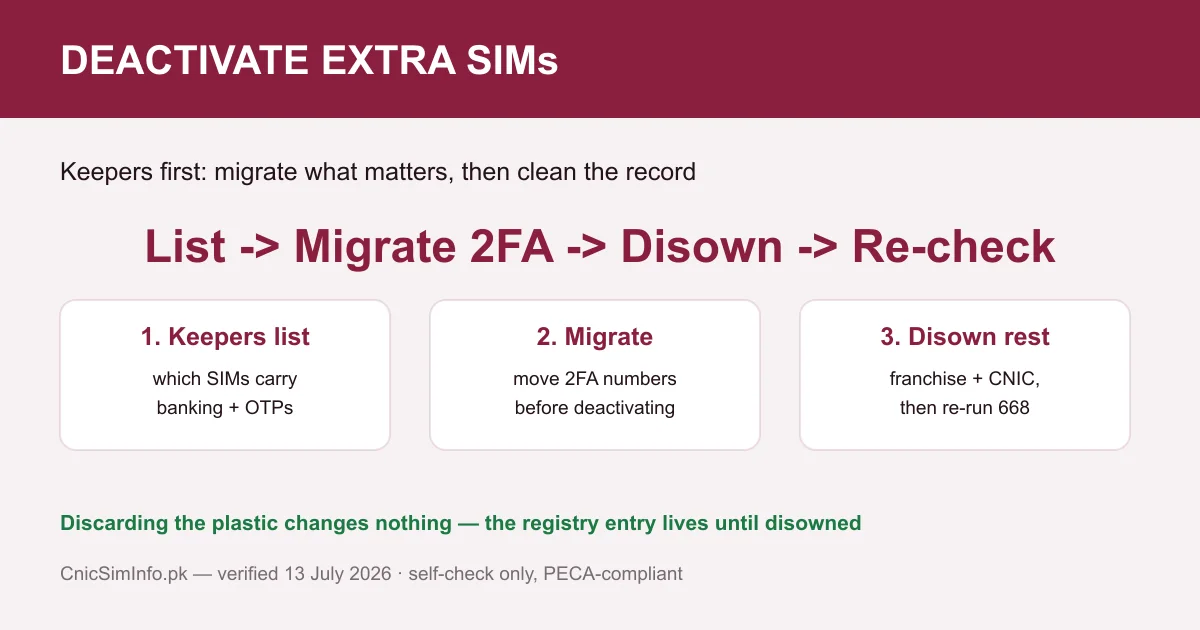
To deactivate extra SIM lines safely, work keepers-first: list every line with 668 or cnic.sims.pk, move your banking and OTP numbers to a keeper, then disown the rest at a franchise. Cancellation comes last, never first — that order protects your wallets. The full self-check toolkit lives at Check SIM Owner Details Pakistan.
Key takeaways
- List first: 668 (about Rs 2) or the free cnic.sims.pk portal shows every line on your CNIC.
- Migrate banking, JazzCash–Easypaisa and 2FA numbers before deactivating anything.
- Only franchise disowning updates the registry — fee capped at Rs 200, waived in fraud cases.
- Binning the plastic removes nothing; the entry stays on your record until disowned.
- Re-run 668 a few days later to confirm the count actually dropped.
Scope: this page trims lines registered on your own CNIC, with your own documents. Reading anyone else’s record is a different act entirely, priced in years and fines on our PECA legality page.
On this page
See the full roster before you cut
You cannot trim what you cannot see, so start with the registry rather than memory. SMS your 13-digit CNIC, digits only, to 668 for about Rs 2, and the reply lists your SIM count on every network. The free cnic.sims.pk portal shows the same roster from anywhere, with an activation date beside each line. Between them you get the one number that matters today: how many lines your identity carries against the cap of eight, five voice plus three data.
Read the reply with the 668 guide, the dates with the portal walkthrough, and any oddity with the count decoder. One warning is worth planting before the scissors come out. A line you never bought is not an “extra” — it is somebody else’s act wearing your name, and the unauthorized-SIM page treats it as the incident it is.
Which SIM to keep: the decision table
Most people cancel in the wrong order. They keep the SIM with the prettier number and disown the one their bank still texts. Run every line through this table before anything gets touched.
| The line in question | Verdict | Why |
|---|---|---|
| Receives banking, JazzCash or Easypaisa OTPs | Keep | Your money routes through it; migrate duties first, decide later |
| Daily caller known to family and offices | Keep | Its age is its value; replacing it costs months of updates |
| Data SIM in a router, tablet or second phone | Keep if used monthly | Dormant device lines quietly lapse while still holding a slot |
| Drawer SIM, last recharged over a year ago | Disown | Operators quote dormancy windows that vary; long-dead numbers can be recycled |
| A number you do not recognise | Report, do not quietly disown | Follow the unauthorized-SIM steps so the record shows fraud, not consent |
Where two keepers compete on the same network, age usually wins — an old number is identity infrastructure, known to banks, schools and half your relatives. Fresh spares are replaceable. Decade-old numbers are not.
Move your OTPs before anything else
Deactivating a number that still receives your bank codes is self-inflicted lockout. Move duties across before any franchise visit: banking profiles, JazzCash and Easypaisa wallets, WhatsApp, email recovery, plus every app that texts you a code. Each migration fires a confirmation OTP at the old number, which is exactly why the old SIM must still be alive while you do this. Dead first, migrated second does not work.
Then give the keeper a week of normal use. Stray codes will surface the accounts you forgot, and an account remembered before disowning costs nothing. The same account remembered afterwards can cost a frozen wallet and a long support queue.
Franchise disowning: the only real exit
No SMS, app or dial code removes a SIM from your record. The exit is physical: a franchise or customer-service centre, your original CNIC, a live biometric, and a disowning request against the specific number. PTA caps the fee at Rs 200 and waives it entirely in fraud cases, under its 1 January 2024 direction. Every search for “remove SIM from CNIC” ends at this same counter.
Two timing rules are worth knowing before you go. New SIMs carry a 365-day disowning-and-transfer lock under PTA’s advisory of 24 May 2026, so a recently issued line may refuse to leave early. And if the CNIC behind your lines has itself expired, sort the expired-CNIC problem first, because the counter needs a valid document. The counter-by-counter walkthrough, wording included, sits on the block and disown guide; a late relative’s numbers follow the heirs’ route on the deceased-person SIMs page.
Why binning the plastic changes nothing
Snapping the card in half feels final. The registry disagrees. Your CNIC-to-SIM link lives in operator and PTA systems, not in the chip, so a discarded SIM stays on your record: still counted against your cap, still your name in every audit, still your responsibility if it resurfaces.
Dormancy adds its own fine print. Operators commonly quote deactivation windows in the region of 180 days of zero use — confirm the figure with yours — and after long dormancy a number can be recycled to a stranger. Recycled is not removed. Until you disown the line, its paper trail still points at you, and a number you actually meant to keep is better rescued through the reactivation guide than mourned.
Re-run 668 and close the loop
A few days after the franchise visit, send your CNIC to 668 again. The count should have dropped by exactly the lines you disowned, and the portal’s date view confirms which entries vanished. Give a stubborn entry a week, since registry timings vary by operator, then escalate: helpline first, PTA at 0800-55055 second.
A deactivate extra SIM job is finished when the registry says so, not when the counter clerk does. Afterwards, make the audit a monthly habit — two minutes on 668 catches drift early, the status routine covers lines that stop working on their own, and the myth list keeps helpful uncles from undoing your good work.
Roman Urdu mein
Extra SIM band karwane ki sahi tarteeb yeh hai: pehle 668 (taqreeban Rs 2) ya cnic.sims.pk se poori list dekhein. Phir jo number banking, JazzCash ya Easypaisa ke OTP leta hai usay kisi keeper SIM par shift karein — yeh kaam sab se pehle, warna apna hi account lock ho jayega. Uske baad franchise par asal CNIC aur biometric ke saath faltu lines disown karwayein; fee zyada se zyada Rs 200, fraud ho to maaf. SIM tor kar phenk dena deactivate nahi hai — record tab tak aap ke naam rehta hai jab tak disown na ho. Aakhir mein 668 dobara bhej kar tasdeeq karein ke count sach mein gira.
Frequently asked questions
Can I deactivate extra SIM lines just by calling the helpline?
A helpline can block or suspend a line, which stops usage, but the CNIC registry entry survives the call. Removal is a franchise act: original CNIC, live biometric, disowning request against the specific number. The fee is capped at Rs 200 and waived where fraud is involved.
What happens if I simply throw the extra SIM away?
The registration outlives the plastic. It keeps occupying your 8-SIM cap, stays your legal responsibility, and after long dormancy the number can even be recycled to a stranger while the old paper trail still carries your name. Disown it properly instead.
Which SIM should I keep if two are on the same network?
Keep the one your banks, wallets and family already know, which usually means the older number. Shift any OTP or 2FA duty off the spare, run the keeper for a week to catch strays, then disown the spare at the franchise.
How long before 668 shows the lower count?
Most people see the drop within days, though timings vary by operator. Re-check with 668 after about a week, confirm on cnic.sims.pk, and if a disowned line refuses to leave the record, escalate to the operator and then PTA at 0800-55055.
Can I remove a SIM from my CNIC while living abroad?
Checking is the easy half from abroad: cnic.sims.pk works worldwide and accepts NICOP. Disowning is a biometric act, so it generally waits for a Pakistan visit; some operators describe overseas routes of their own, and their helpline is the place to confirm one before you rely on it.

Written and reviewed by Muhammad Hamza, founder and editor of CnicSimInfo. The keepers-first sequence is checked against PTA’s published disowning rules — the Rs 200 fee cap with fraud waiver (1 January 2024) and the 365-day new-SIM lock advisory (24 May 2026) — and against live 668 and cnic.sims.pk replies. Last reviewed: 13 July 2026. See our editorial standards.