Two more answers people ask the glossary for
Where do MNP (porting) complaints go?
Start with the new operator’s helpline, since porting runs through their franchise. If it stalls past the usual four working days, escalate to PTA at 0800-55055 or complaint.pta.gov.pk with your porting reference number.
CNIC vs NICOP for SIM checks — any difference?
Functionally none on the portal: cnic.sims.pk accepts CNIC, NICOP and POC numbers alike. The difference is who holds them: NICOP/POC belong to overseas Pakistanis, which is why the portal (not 668) is the natural overseas route.
Speak the Language
SIM Verification Glossary — SVMS, BVS, DIRBS & MNP (2026)
What do Pakistan’s SIM terms actually mean? This sim verification glossary explains the ten terms behind every SIM check in plain words: SVMS, BVS/MBVS, DIRBS, LSDS, MNP, NICOP/POC, SIM Disowning, FRC, CNIC/B-Form, and the activation date. Each one links to where it matters in our main guide, Check SIM Owner Details Pakistan.
Key takeaways
- SVMS is the subscriber verification registry every legal check reads.
- BVS/MBVS is the biometric activation layer: a live NADRA fingerprint match before any SIM turns on.
- DIRBS governs devices by IMEI (check via 8484) — SIMs and phones are separate systems.
- MNP is number porting, and it is why prefixes stopped proving networks.
- SIM Disowning removes a registry entry at the franchise; keep the reference number.
You don’t need jargon to check your SIMs, but the moment you read a PTA notice, visit a franchise, or file a complaint, these words start flying around. Two minutes in this glossary and none of them will confuse you again.
On this page
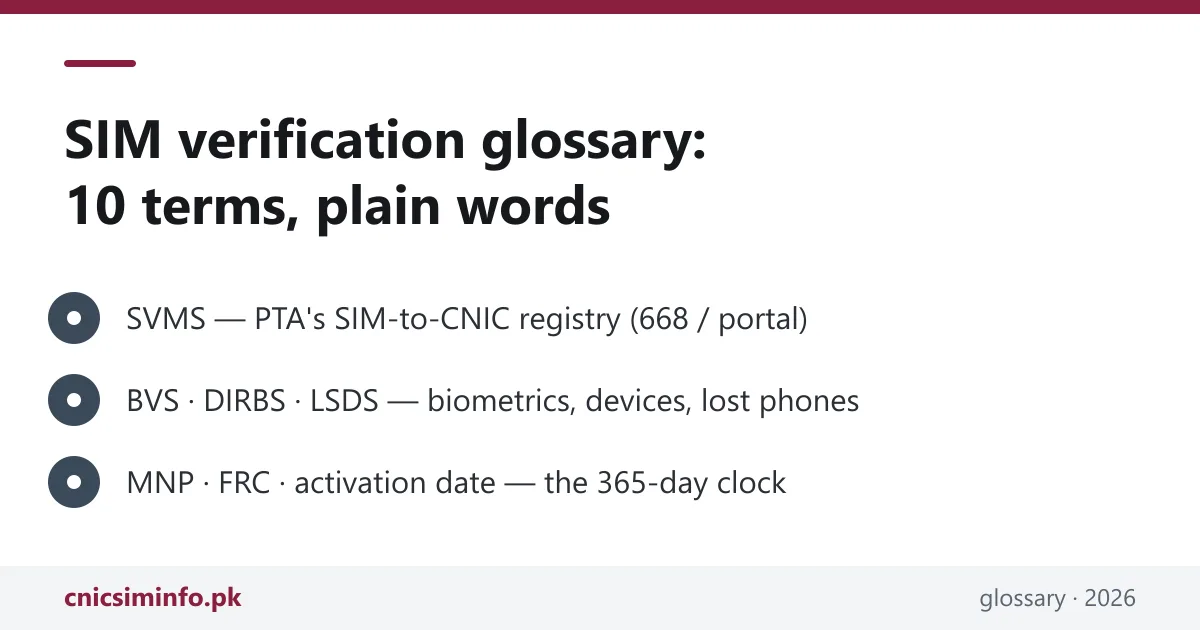
The glossary: 10 terms in plain words
SVMS — Subscriber Verification Management System
PTA’s national registry: it links every biometrically activated SIM in Pakistan to a CNIC and powers both the 668 SMS check and the cnic.sims.pk portal. It has no public API, for anyone. That’s why no website can legally show a stranger’s SIM owner details.
BVS / MBVS — (Multi-)Biometric Verification System
NADRA’s fingerprint system, the step that activates a SIM and ties it to your CNIC. You can check your own status with your operator’s code: Jazz CNIC to 6001, Telenor CNIC to 7751, Zong V to 7911, Ufone *336*1#, with the full status-and-fix walkthrough on our BVS page, with details in Method 5.
DIRBS — Device Identification, Registration and Blocking System
PTA’s device registry, governing handsets by IMEI (SMS yours to 8484) and deciding whether a phone may use Pakistani networks. It’s Pakistan’s system (CEIR is India’s), and it does not enforce the SIM limit; enforcement happens at activation, through SVMS and NADRA.
LSDS — Lost & Stolen Device System
PTA’s blocking service for lost or stolen phones: file a police FIR first, then lodge a request with the phone’s IMEI. The handset gets blocked on all networks, usually within about 24 hours, and can be unblocked if you recover it; the steps live in the device section.
MNP — Mobile Number Portability
Keep your number, change networks. Porting happens at the new operator’s franchise with your original CNIC and takes about four working days. It’s also why prefixes mislead: a 0300 number may live on Zong today. Confirm any number’s real network with N 03XXXXXXXXX to 76367. What a bare number can and can’t reveal: the by-number answer.
NICOP / POC — overseas identity cards
The National Identity Card for Overseas Pakistanis and the Pakistan Origin Card. Both work exactly like a CNIC on cnic.sims.pk, which makes the portal the natural route for checking SIMs from abroad, no Pakistani SIM needed.
SIM Disowning — the counter-phrase
The official franchise process that removes a SIM from your CNIC, done in person with your original CNIC and a fingerprint. Say those exact words at the counter, keep the written reference number, and re-check after 24 to 48 hours — the full plan sits in found an unknown SIM?
FRC — Family Registration Certificate
A NADRA document proving family relationships: you need it, along with the death certificate and CNICs, to block or transfer a deceased relative’s SIMs at the franchise. Move within about 30 days, because unattended records are a known fraud route.
CNIC / B-Form — adult ID and child registration
The CNIC is the 13-digit adult identity card every SIM registers against. A B-Form, by contrast, is a child’s registration document, and no SIM can be issued on it. A minor’s SIM sits on a parent’s or guardian’s CNIC, counting toward that adult’s cap of eight, until the child turns 18.
Activation date — the 365-day clock
The SVMS timestamp recording when a SIM was biometrically switched on. You’ll see it on the cnic.sims.pk portal, and it matters: since PTA’s advisory of 24 May 2026, a new SIM can’t be disowned or transferred for 365 days from this date. Screenshot it — it’s your evidence and your timer.
How the systems connect (one flow)
Here’s the whole machine in one line: you buy a SIM. NADRA’s MBVS matches your fingerprint to your CNIC, and the activation gets written into SVMS, with its activation date. From then on, 668 and cnic.sims.pk can count that SIM against your identity.
The device side runs separately: DIRBS checks whether your handset’s IMEI may use Pakistani networks, and LSDS blocks it if it’s stolen. SIM and phone are two different records, which is why selling your phone doesn’t move your SIM, and blocking your SIM doesn’t block your phone.
And when something’s wrong — a SIM you never bought, a number that needs to leave your name — SIM Disowning at the franchise is the exit door. One registry, three systems, one counter-phrase. This sim verification glossary is the map; the full guide is the manual.
Frequently asked questions
Is SVMS the same as the 668 service?
Not quite. SVMS is the registry itself, PTA’s master record of SIM-to-CNIC links. 668 and cnic.sims.pk are the two public windows that read a privacy-safe summary of your own entry: a count per operator, never the full record.
Does Pakistan use CEIR to block phones?
No. Pakistan uses DIRBS for device compliance and LSDS for lost-phone blocking. CEIR is India’s system, so any guide telling Pakistanis to use “CEIR” has the wrong country — check your device by texting its IMEI to 8484 instead.
Why does the activation date matter so much?
Because it starts the 365-day disowning lock. Since PTA’s late-May 2026 advisory, a newly activated SIM can’t be disowned or transferred for a year. The portal shows each SIM’s activation date, so a dated screenshot proves exactly when a rogue SIM appeared on your CNIC.

Written and reviewed by Muhammad Hamza, founder and editor of CnicSimInfo. Every definition here traces to PTA, NADRA or the statute itself, and the whole glossary is re-verified quarterly. Last reviewed: 8 July 2026. See our Editorial Standards and the full SIM owner details guide.