Family Guide · Deceased CNIC Records
Deceased Person SIMs: Block, Transfer or Disown, Step by Step
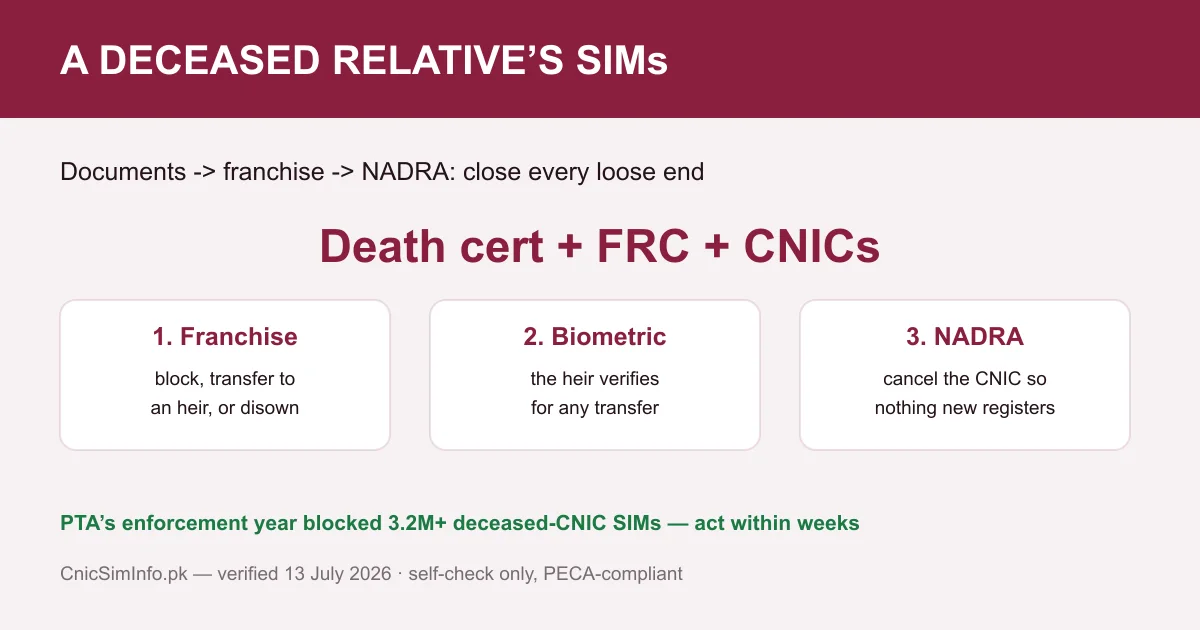
When a loved one passes away, their SIMs stay active until the family acts. Gather the death certificate, the heir’s CNIC and NADRA’s Family Registration Certificate. Then visit each operator’s franchise to block, transfer or disown every line, and finish by cancelling the CNIC at NADRA. The wider toolkit lives at Check SIM Owner Details Pakistan.
Key takeaways
- Every SIM on a deceased CNIC keeps working — and keeps receiving OTPs — until the family closes it.
- Papers first: death certificate, heir’s CNIC, NADRA’s FRC, and the deceased’s CNIC if you still have it.
- Per SIM, three choices at the franchise: block it, transfer it to an heir (biometric), or disown it.
- Finish at NADRA: cancel the CNIC so nothing new can ever register against that identity.
- PTA’s Jul 2024–Jun 2025 enforcement year blocked 3.2M+ deceased-CNIC SIMs — families who wait are in that queue.
This is paperwork nobody wants, written to be finished in weeks, not months. Settling your own family’s record is fully legal; the line that never moves — identity lookups on strangers — is mapped on our PECA 2016 legality page.
On this page
Why this cannot wait for the sweep
A SIM does not read the news. It keeps receiving OTPs after its owner has passed, and keeps standing as a registered identity. That makes an unattended line the softest target fraud knows, which is why deceased person SIMs sit so high on PTA’s enforcement agenda.
The scale of this problem is a matter of public record. In its July 2024 to June 2025 enforcement year, PTA blocked more than 3.2 million SIMs registered on deceased CNICs. Our report on that campaign unpacks how the sweep worked. A regulator’s broom is slow, though, and it sweeps bluntly. Families who act within weeks, not months, close the risk on their own schedule and keep any number worth keeping.
Step one: see what the CNIC carries
Start with the map, not the counter. SMS the 13-digit CNIC, no dashes, to 668 and the reply lists each operator’s SIM count for about Rs 2. The free PTA portal at cnic.sims.pk shows the same record with activation dates. It works from anywhere in the world, NICOP and POC included — a mercy for heirs abroad.
Note every operator with a count above zero. Each one is a separate franchise errand, so siblings who split the list save days. Screens and replies are decoded in the 668 guide, the portal walkthrough and the count decoder.
The four documents that open every counter
| Document | Issued by | Why the counter wants it |
|---|---|---|
| Death certificate | Union Council / NADRA | Proves the passing; the anchor of the whole file |
| Heir’s original CNIC | NADRA | Identifies the person acting; photocopies alone fail |
| FRC (Family Registration Certificate) | NADRA | Proves the relationship between heir and deceased |
| Deceased’s CNIC | If still held | Speeds matching; its absence does not stop the process |
The FRC deserves a word of its own, since many families first meet it here. NADRA issues it from the family tree held in its own records. It is the paper that ties the heir standing at the counter to the name on the death certificate. Ask for it early. It tends to be the slowest mover of the four.
Operators keep their own fine print, and a franchise may add an internal indemnity form. Even SCOM, the operator serving AJK and Gilgit-Baltistan, publishes this exact process on sco.gov.pk — a sign of how routine the file has become. Bring originals with one photocopy set and few counters will turn you back.
At the franchise: block, transfer or disown
- Visit a franchise of each operator on your list, documents in hand.
- Decide per SIM: block it, transfer it to an heir, or disown it.
- For a transfer, the heir attends in person and verifies by fingerprint.
- Collect the confirmation slip or SMS before leaving, every time.
Blocking suits lines nobody needs again. Transfer suits the number that a decade of contacts, bank alerts and the family WhatsApp all know. Ownership moves onto the heir’s CNIC through live biometric verification at the counter. Disowning formally declares that a line was never the family’s at all. The fee is capped at Rs 200 and waived outright in fraud cases under PTA’s 1 January 2024 direction, with the full playbook in our block-and-disown guide.
The last stop: cancel the CNIC at NADRA
Franchises close the lines that exist. NADRA closes the door on lines that do not exist yet. Report the death and have the CNIC formally cancelled, and that identity can never anchor a fresh SIM at any counter in the country. Skip this step and the file stays half shut.
Cancellation also cleans the registry that PTA’s sweeps read, so the record ends tidy on both sides. If a line later surfaces that should not, the blocked-SIM check and the unknown-SIM guide pick up the trail. An expired card is a different problem entirely, handled in the expired-CNIC guide.
Roman Urdu mein
Kisi apne ke inteqal ke baad un ki SIMs khud band nahi hoti. Pehle 668 par CNIC SMS kar ke ya cnic.sims.pk se dekhein ke kitni SIMs kis operator par hain. Phir death certificate, apna CNIC aur NADRA ki FRC le kar har operator ki franchise jayein. Har SIM ke liye teen raaste hain: band karwana, kisi waris ke naam biometric transfer, ya disown. Aakhir mein NADRA se CNIC cancel karwayein taake us shanakht par koi nai SIM kabhi na nikle. Yeh kaam hafton mein karein, mahinon mein nahi — PTA ne July 2024 se June 2025 ke aik saal mein 32 lakh se zyada aisi SIMs block ki hain.
Frequently asked questions
Can we keep using our late father’s number?
Yes, by making it yours. Take the death certificate, NADRA’s FRC and your own original CNIC to the operator’s franchise and transfer the number to an heir through live biometric verification. The number survives; the registration finally tells the truth.
What documents are needed for a deceased CNIC SIM transfer?
Death certificate, the heir’s original CNIC and NADRA’s Family Registration Certificate, plus the deceased’s CNIC if the family still holds it. Some franchises add an internal form of their own, so carry originals and one photocopy set.
Do the SIMs not get blocked automatically when someone dies?
Eventually, perhaps — PTA’s July 2024 to June 2025 enforcement year blocked over 3.2 million such SIMs, but sweeps run on the regulator’s clock and fraud runs faster. Families who act within weeks close the risk on their own terms.
Is it legal for me to check my late parent’s SIM record?
Settling a parent’s record as an heir is exactly what 668 and the cnic.sims.pk portal exist for. What PECA 2016 Section 16 punishes — with up to three years in prison, a Rs 5,000,000 fine or both — is prying into strangers’ identities, and that boundary holds in every case.
We live abroad. Can this be done remotely?
The audit side, yes: cnic.sims.pk works worldwide and accepts NICOP and POC holders. Transfers, though, are biometric and happen at a franchise inside Pakistan. Most families time it with a visit home and ask the operator about blocking the line in the interim.

Written and reviewed by Muhammad Hamza, founder and editor of CnicSimInfo. The document list and franchise routes follow operator counter practice and SCO’s published guidance on sco.gov.pk; the 3.2 million figure is PTA’s own enforcement-year reporting. Last reviewed: 13 July 2026. See our editorial standards.