
How We Work
Editorial Standards
Last reviewed: 6 July 2026. These editorial standards explain how CnicSimInfo sources, checks and corrects everything it publishes.
On this page
1. Our Editorial Standards & Mission
CnicSimInfo exists to be the one Pakistani SIM-information resource that is accurate, legal and genuinely useful. That starts with our main guide: Check SIM Owner Details Pakistan. Our commitment is simple: every fact must be traceable to a named, credible source, and we never trade accuracy for traffic.
2. Sourcing Policy
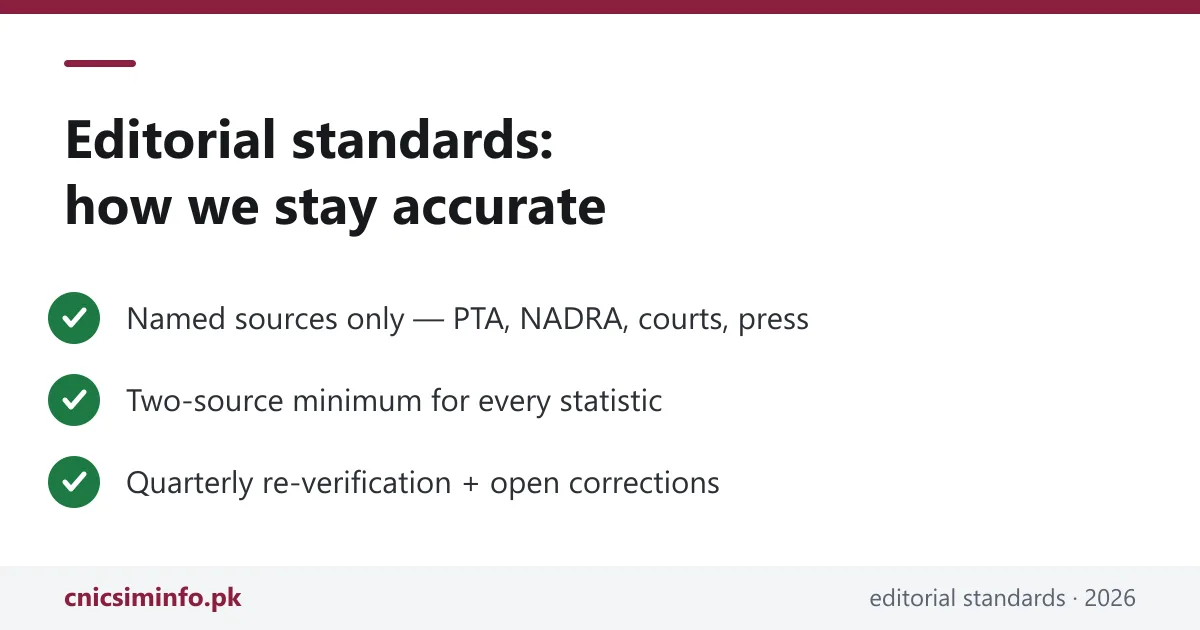
We prioritize primary and official sources: PTA notices and short-code lists, NADRA advisories, the Supreme Court of Pakistan, the PECA 2016 statute, PKCERT and the NCCIA. Named, reputable Pakistani news outlets (e.g. Dawn) complete the list. Tertiary or crowd-edited summaries are not used as sole sources.
3. Fact-Checking Process
Before publishing, each code, fee, date, statistic and legal claim is cross-checked against an official source. Claims supported by only one weak source are held back until corroborated.
4. Our Accuracy Advantage
We explicitly reject fabricated claims that circulate on competing sites — invented “advisories”, wrong penalty figures, drifting SIM-limit numbers and unverifiable statistics. Where a “fact” appears as different numbers on different sites, we treat it as fabricated and do not publish it.
5. Authorship & Expertise
Content is written and edited by Muhammad Hamza, founder and editor of CnicSimInfo, who follows Pakistan’s telecom and identity rules closely and writes from hands-on use of the official methods. Articles carry a byline linking to the About page.
6. Review & Update Cadence
The whole guide is reviewed at least quarterly, rule changes get dated entries in our PTA SIM news changelog, and each page shows a “last reviewed” date. Time-sensitive items (codes, fees, rules) are updated as soon as official changes are confirmed.
7. Corrections Policy
Spotted an error? Tell us via the Contact page with the page URL and the specific claim. We verify in good faith and fix confirmed errors promptly, noting substantive corrections openly.
8. Independence & Ad Disclosure
Advertising (Google AdSense) never influences our content or recommendations. Ads are clearly labelled and separate from editorial. We sell no data and use no paid-lookup CTAs.
9. What We Will Not Publish
No help with illegal stranger-lookups; no third-party “enter any number” tools; no dark-web or paid-data links or CTAs; no unverified statistics or fabricated advisories/penalties. Illegal lookups violate PECA 2016.
AI assistance, disclosed
Drafting on this site is assisted by AI tools; accuracy is not. Every number, date, code and legal claim is verified by the editor against the named source before publication, and nothing is auto-published, ever. When AI helps arrange a sentence, our editorial standards still decide what the sentence is allowed to say. If a claim can’t be traced to a statute, a regulator, a court or named national press, it doesn’t run. The same rule produced our public list of fabrications that circulate elsewhere, from invented advisories to penalties no law contains.
The verification ladder
Sources rank in a fixed order: the statute itself, then regulator documents (PTA, NADRA, NCCIA, PKCERT), then court orders. After that comes named national press (Dawn, Express Tribune, Geo, ProPakistani, Profit), then operator pages for their own codes. Statistics need two independent rungs of that ladder before they’re published, every claim carries its date, and anything that fails the ladder gets a verdict on our myths page instead of a citation.
Why quarterly re-verification instead of yearly?
Because Pakistan’s SIM rules genuinely move: within one recent year the disowning lock went from 60 to 365 days, midnight sales were banned and a major operator merged. Quarterly is the slowest cadence these editorial standards can defend, and dated changes land in the changelog within days, not quarters.
Do advertisers or networks influence what gets published?
No. Ads are served and labeled separately, no advertiser sees content before readers do, and no page has ever been written to please a network. The clearest proof is the archive of pieces naming and dismantling the lookup-site industry, the most monetizable topic we refuse to monetize.
FAQ
Frequently asked questions
How does CnicSimInfo verify its facts?
Every code, fee, date and legal claim is cross-checked against a named, official source — PTA, NADRA, the Supreme Court of Pakistan, the PECA 2016 statute, PKCERT or the NCCIA — before it is published.
Who writes and reviews the content?
It is written and edited by Muhammad Hamza, founder and editor of CnicSimInfo, who follows Pakistan’s telecom and identity rules closely.
How often is the guide updated?
The whole guide is reviewed at least quarterly, and time-sensitive items are updated as soon as official changes are confirmed.