
Method Guide · The Code Behind the Name
667 SIM Owner Name: What the MNP Code Really Shows
Text the word MNP to 667, and the reply shows who the SIM in your phone is registered to. That is the real 667 SIM owner name check. PTA’s MNP Porting Process Guidelines list what comes back: the mobile number, the registered name, the CNIC and the activation date. The check works only from the SIM itself, so it can never name a stranger. It is step one of number portability, borrowed as the 667 SIM owner name self-check. The full lawful toolkit lives at Check SIM Owner Details Pakistan.
Key takeaways
- Send MNP to 667 from the SIM you want to verify. The reply is that SIM’s own registration record, at standard SMS rate.
- PTA’s MNP Porting Process Guidelines V7.9.15, section 4.1.1 list the reply fields: the MSISDN, the name, the CNIC and the date of activation.
- On live networks, part of the CNIC usually arrives masked. You get enough to confirm the 667 SIM owner name record is yours, never enough to expose a document.
- 667 answers only for the card that sends the SMS. You cannot text a stranger’s number to 667 and receive their name.
- No lawful channel returns a stranger’s identity. Section 16 of PECA 2016 sets the penalty: up to 3 years, up to Rs 5,000,000, or both.
- Run it before disowning a doubtful SIM, after buying a used phone that came with a SIM, and on every drawer SIM you rediscover.
- Pair it with 668, which counts every SIM on your CNIC, and the free cnic.sims.pk portal.
Why does a porting code answer an ownership question? Because a port cannot begin until the donor network states, in writing, who a number is registered to. PTA built that statement into the very first SMS of the porting journey. This page reads that SMS field by field, shows where it ends, and names the law that stands past that line.
On this page
What does the 667 SIM owner name check return?
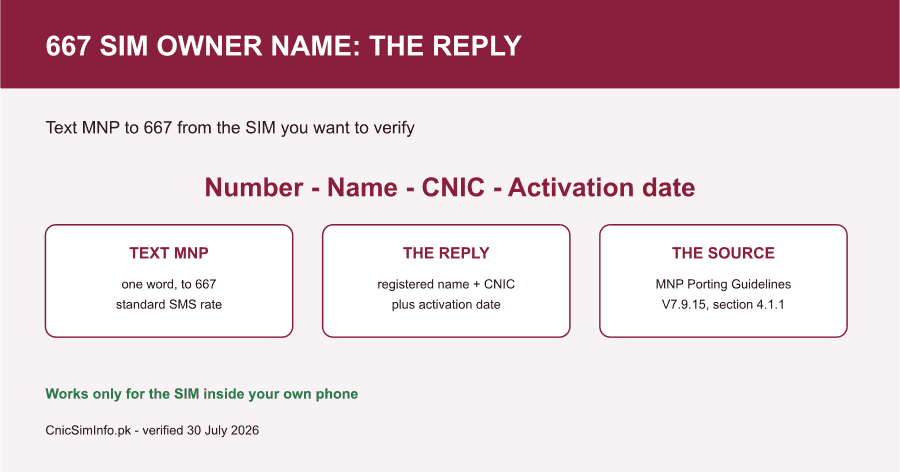
The 667 SIM owner name check returns the registration record of the SIM that sent the SMS. Under section 4.1.1 of PTA’s MNP Porting Process Guidelines, version 7.9.15, the reply to the word MNP carries four fields: the mobile number, called the MSISDN, the registered name, the CNIC, and the date of activation. One standard-rate SMS buys the whole 667 SIM owner name record, and that field list still stands as of August 2026.
Those four fields exist for a precise reason. 667 is the pre-porting verification step of Mobile Number Portability. Before a number moves from one network to another, the subscriber is expected to see the record the donor network holds, exactly as it stands. A port filed against a mismatched record stalls at the franchise counter. So the system shows you the record first, and that design is what makes 667 the only code in Pakistan that ever prints a registered name.
Two practical notes keep expectations honest. First, live replies do not always print every field in full. Operators commonly mask part of the CNIC digits, and some replies shorten to a registration status line. The masking is deliberate, because an SMS can be read by whoever later holds the phone. Second, the name that arrives is the record holder’s, which is not always the person holding the handset. A SIM bought for you by a parent replies with the parent’s record, and that is the registry working correctly.
The record itself sits in the same registry that powers every legal check on this site: PTA’s Subscriber Verification Management System, the database behind 668 and the cnic.sims.pk portal. 667 simply enters that registry through the card instead of the CNIC.
How do you run the 667 SIM owner name check?
Seat the SIM in a phone, text the single word MNP to 667, and read the reply. That is the entire 667 SIM owner name routine. It needs no internet, no app and no account, and it behaves the same on Jazz, Zong, Telenor and Ufone, because 667 is PTA’s network-neutral porting code.
- Seat the SIM you want to verify in any working handset, and give it a moment to catch signal. The handset’s brand never matters; the card is what answers.
- Type the single word MNP in a new SMS. No CNIC, no phone number, no punctuation. Extra words are the most common reason a reply never comes.
- Send it to 667. Your operator’s standard SMS rate applies, usually a rupee or two, and the reply itself is free.
- Read the reply against your own document. Number, name, CNIC and activation date, per the MNP guidelines. Where digits arrive masked, match the visible fragment to your CNIC.
- Screenshot the reply with its date. If the card later goes to a franchise for correction, transfer or disowning, that screenshot is your before picture.
What should the answer trigger? A record that matches your document means the card is yours on paper as well as in pocket, and you are done. A registered name that is not yours means the card sits on someone else’s record, and the honest next step is a franchise counter, not continued use. No reply at all usually means the SIM has no service or the message carried extra words. All twelve lawful routes, including what to do with each answer, sit on our check SIM owner details hub.
Can 667 show a stranger’s SIM owner name?
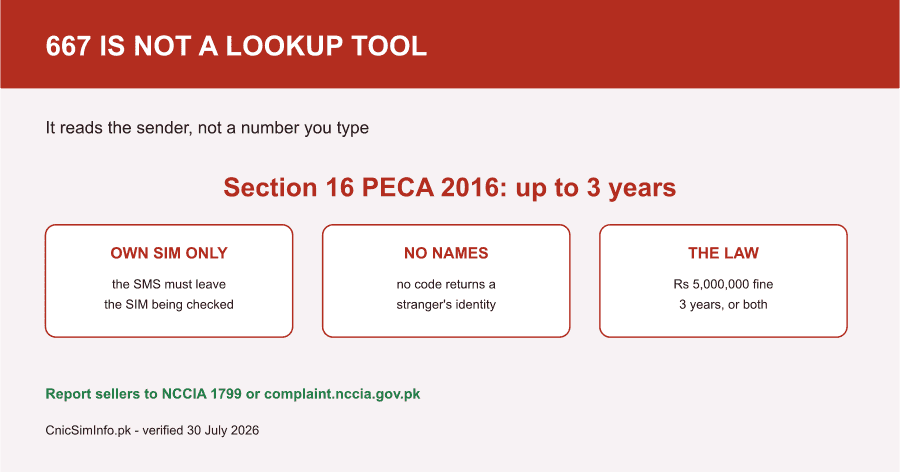
No. The 667 SIM owner name query travels from the SIM being checked, so the only record it can ever open belongs to the card inside your own phone. Typing someone else’s number into the message does nothing, because the code reads the sender, not the text. There is no version of the 667 SIM owner name check that names a stranger.
The claim: “667 code sim owner check for any number”
FalsePages and videos keep promising a 667 SIM owner name result for any Pakistani number. The mechanics make that impossible. 667 is a pre-porting handshake between a SIM and its own network, and possession of the card is the consent built into it. A code that must be dialled from the SIM itself cannot be aimed across the street, let alone across the country.
The boundary is legal as well as physical. Obtaining another person’s identity information without consent is an offence under Section 16 of PECA 2016, and the penalty runs to 3 years in prison, a fine up to Rs 5,000,000, or both. The statute, with what it does and does not cover, is mapped on our PECA 2016 legality page. Services that sell “sim owner name 667” results for strangers are not reading any registry; our by-number reality check shows what they actually recycle, and where their material comes from.
If a website, app or agent offers you a stranger’s name for a fee, walk away and report it. NCCIA takes these complaints on 1799 and at complaint.nccia.gov.pk, and PTA takes them on 0800-55055. The safe rule has one line: the 667 SIM owner name check verifies the SIM in your hand, and nothing else.
667 vs 668 vs 76367: which code answers what?
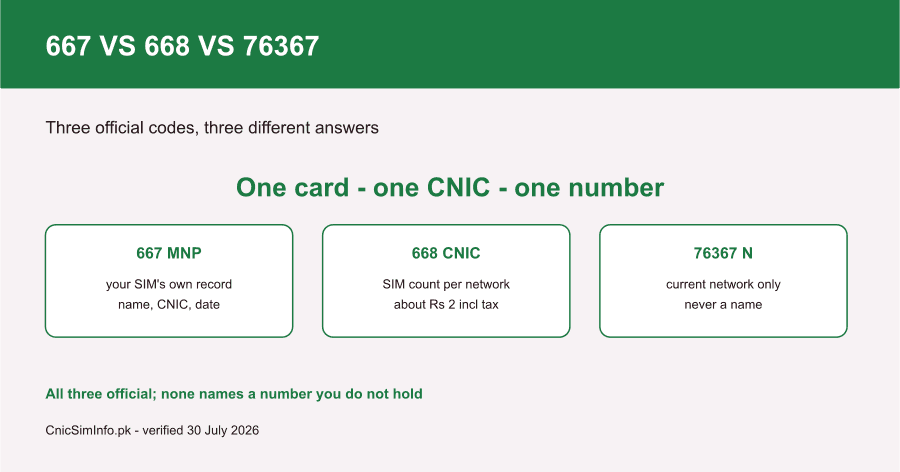
Three codes, three different questions. The 667 SIM owner name code reads the one card that sends the SMS. 668 counts every SIM on the CNIC you type. 76367 names a number’s current network, and nothing more. Here is the whole picture in one table.
| Question | 667 | 668 | 76367 |
|---|---|---|---|
| What you send | The word MNP | Your 13-digit CNIC, digits only | N, a space, then the number |
| What it audits | The SIM that sends the SMS | Every SIM on that CNIC | One phone number |
| Reply contains | Number, name, CNIC and activation date, per the MNP guidelines, with digits often masked | Per-network SIM counts | The current network only, never a name |
| Cost | Standard SMS rate | About Rs 2 including tax | About Rs 2 |
| Needs the SIM in hand | Always | Never; any Pakistani SIM can send it | Never |
| Can it name a stranger? | No | No | No |
| Full guide | 667 SIM check | 668 SMS check | 76367 network check |
Notice the last row before the links. All three official codes refuse the same request. None of them, at any price, names the owner of a number you do not hold. That refusal is not a gap waiting for a clever app; it is the design, and it is what separates the official registry from the scam sites that borrow its vocabulary. The free browser route, the cnic.sims.pk portal, holds the same line: your own CNIC, your own record, nothing else.
When should you run the 667 check?
Run the 667 SIM owner name check any moment a SIM’s paper trail matters more than its signal. It costs a rupee or two and takes under a minute, so the honest answer is: whenever doubt appears. Five situations cover almost every real case.
- Before porting a number. This is 667’s native job. Confirm the record before you file the request, because a mismatch surfaces cheaply at home and expensively at the counter.
- Before disowning a SIM. Disowning removes a SIM from your record, and PTA capped the fee at Rs 200 from 1 January 2024, waiving it in fraud cases. Run the 667 SIM owner name check first, so you disown the right card. Remember the timing rule: under PTA’s advisory of 24 May 2026, a newly activated SIM cannot be disowned or transferred for 365 days.
- After buying a used phone. Second-hand devices often arrive with a SIM still inside. Verify it with the 667 SIM owner name check before you build a life on it. A card registered to a stranger’s record has no place in your daily phone, whatever data package it carries.
- On every rediscovered drawer SIM. Old cards surface during house cleaning with no memory attached. The 667 SIM owner name reply tells you whose record each one sits on, and 668 tells you whether it still counts against your CNIC’s cap of eight SIMs, five voice plus three data, set by the Supreme Court ruling of 5 November 2015.
- On family hand-me-downs. A parent’s spare SIM in a child’s phone still answers with the parent’s record, because handing over plastic never moves ownership. Transfers happen at a franchise, with both CNICs present.
One habit ties the five together. Whatever the 667 SIM owner name check tells you about the card, let 668 tell you about the record. The pair reads the same registry from both ends, and where their answers disagree, you have found the exact problem worth taking to a franchise. Keep both replies as dated screenshots in one folder on your phone. Franchise staff act faster on a dated record than on a spoken account, and the NCCIA helpline 1799 asks for evidence in the same shape. A minute of filing after each check turns a cheap SMS into the strongest document you hold, and the 667 SIM owner name screenshot is the one you will reach for first.
Frequently asked questions
What exactly does the 667 reply contain?
Per section 4.1.1 of PTA’s MNP Porting Process Guidelines, the reply carries the MSISDN, the registered name, the CNIC and the date of activation for the SIM that sent the SMS. On live networks, part of the CNIC usually arrives masked, and some replies shorten to a registration status line.
Can I check the SIM owner name of any number with 667?
No. The MNP message must leave the SIM being checked, so the 667 SIM owner name check can only describe the card in your own phone. Typing a stranger’s number into the SMS does nothing. Obtaining another person’s identity information is an offence under Section 16 of PECA 2016, with up to 3 years, Rs 5,000,000, or both.
How much does the 667 SIM owner name check cost?
One SMS at your operator’s standard rate, usually a rupee or two, and the reply is free. Nobody needs to charge you more for a 667 SIM owner name check. Any website or agent asking for a fee to run a 667 sim owner name check is selling you a message you can send yourself in ten seconds.
Why is the CNIC in my 667 reply partly hidden?
Operators mask part of the digits on purpose, because an SMS stays readable by whoever later holds the phone. The guidelines list the CNIC as a reply field, and the masked fragment is still enough to match against your own card. That balance is deliberate policy rather than a fault: enough of the number to confirm your own record, too little for a finder of the phone to copy a full identity from an old message. Full details of your record live behind the cnic.sims.pk portal and 668.
What if the 667 SIM owner name reply shows a name that is not mine?
The card sits on someone else’s registration record. Stop using it as your daily SIM and take it to the operator’s franchise with your original CNIC. Ownership moves only through biometric verification there, and a card you cannot claim should be returned or replaced. Unlawful activity on a SIM is attributed to the person it is registered to.
Does the 667 SIM owner name code work on Jazz, Zong, Telenor and Ufone?
Yes. 667 is the national MNP short code, so the same word MNP works from every major network at standard SMS rate. The code belongs to the porting framework rather than to any single operator, which is why the routine never changes when you switch networks.
Roman Urdu mein
667 SIM owner name check ka matlab simple hai: jo SIM aap ke phone mein hai, us se sirf MNP likh kar 667 par SMS karein. Jawab mein usi SIM ka registration record aata hai. PTA ki MNP Porting Process Guidelines, section 4.1.1, ke mutabiq is reply mein number, registered naam, CNIC aur activation date shamil hain. Aksar networks CNIC ke kuch digits mask kar dete hain, jo hifazat ke liye hai.
Yaad rahe: yeh check sirf apni SIM ke liye hai. Kisi ajnabi ka number 667 par bhejne se kuch nahi hota, aur kisi doosre shakhs ki shanakht hasil karna PECA 2016 ke Section 16 ke tehat jurm hai, jis ki saza 3 saal tak qaid, Rs 5,000,000 tak jurmana, ya dono hai. Apne CNIC par SIM ginti ke liye 668 par CNIC bhejein ya cnic.sims.pk kholein. Dono raste muft ya taqreeban muft hain, aur dono sirf aap ke apne record ki baat karte hain.

Written and reviewed by Muhammad Hamza, founder and editor of CnicSimInfo. The reply fields on this page come from PTA’s MNP Porting Process Guidelines V7.9.15, section 4.1.1, published on pta.gov.pk, and the flow was re-tested on real SIMs across networks. Legal references follow the text of PECA 2016 and dated PTA notices. Last reviewed: 3 August 2026. See our editorial standards.