
Action Series · Status, Triangulated
Check Blocked SIMs on CNIC: What 668 Shows, What the Operator Confirms
To check blocked SIMs on CNIC, accept one honest limit first: 668 and cnic.sims.pk show what is registered, not what is blocked. Count comes from 668, activation dates from the portal, and a line’s actual status from that operator’s helpline. The full self-check toolkit sits at Check SIM Owner Details Pakistan.
Key takeaways
- 668 (about Rs 2) returns your per-operator SIM count — it carries no blocked label.
- cnic.sims.pk adds activation dates: free, worldwide, NICOP accepted.
- Actual line status lives with the operator: Jazz 111, Zong 310, Telenor 345, Ufone 333.
- Triangulate in that order — count, dates, status — and nothing slips through.
- Most blocks trace to unverified biometrics, expired CNICs or enforcement sweeps.
Scope: everything here reads your own record with your own CNIC. Probing someone else’s lines — blocked or otherwise — crosses into PECA Section 16, drawn precisely on our legality page.
On this page
What 668 and the portal actually show
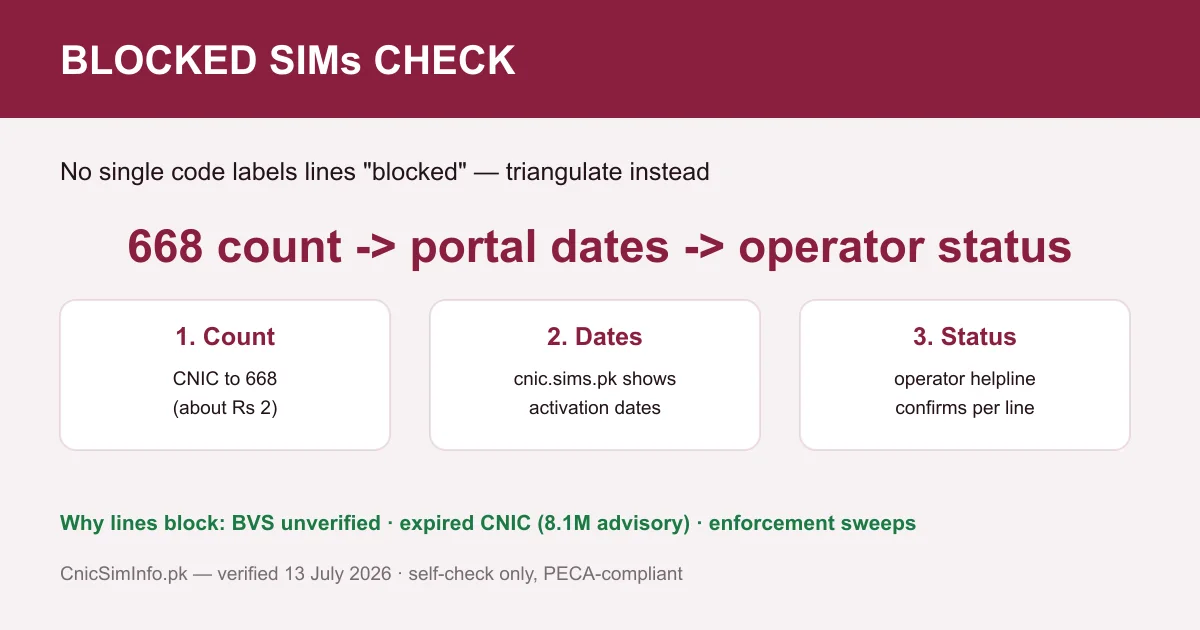
Honest scope before any steps. SMS your 13-digit CNIC, digits only, to 668 for about Rs 2 and the reply is a per-operator count of SIMs registered against your identity. The free cnic.sims.pk portal shows the same roster from anywhere and adds each line’s activation date. That is the entire offer. Neither channel labels any line active, suspended or blocked, because no such column exists in the reply.
So the phrase people search — check blocked SIMs on CNIC — promises a list that no official channel prints. What the channels give you instead is enough: a roster to compare against, and dates that make dormant or unfamiliar entries stand out. The verdict on any single line lives with its operator. Sending format and reply quirks are covered in the 668 guide.
The three-step triangulation
Treat the job as a relay with three legs, each handing off to the next.
| Step | Channel | Cost | What it settles |
|---|---|---|---|
| 1 | SMS your CNIC to 668 | About Rs 2 | How many SIMs each operator holds against your CNIC |
| 2 | cnic.sims.pk portal | Free | Activation date of every line, so dormant entries stand out |
| 3 | Operator helpline or franchise | Free call | Whether a specific line is active, suspended or blocked — and why |
Step three is where the word “blocked” finally gets an official answer. Call from another phone if the suspect SIM is dead, keep your CNIC ready for verification, and ask for the block reason on record, because the reason decides the fix. That relay is the whole method behind check blocked SIMs on CNIC searches: count, dates, verdict. A count you cannot explain belongs on the count decoder before anything else.
Why SIMs get blocked in the first place
Three causes cover most blocks. Biometrics lead: a SIM whose verification never completed, or failed a re-verification round, sits suspended until a live thumb at the franchise clears it — channels and statuses in the BVS guide.
The document behind the SIM is the second trigger. PTA’s advisory of 8 April 2026 flagged 8.1 million SIMs running on expired CNICs; renewal is the way back, sequenced on the expired-CNIC page. Third come enforcement sweeps against fraud numbers and deceased-owner lines — 3.2 million SIMs were blocked across the July 2024 to June 2025 enforcement year, a figure unpacked in our deceased-CNIC blocking report. A late relative’s lines follow the heirs’ route on the deceased-person SIMs page.
Getting a straight answer from the operator
Helplines first: Jazz 111, Zong 310, Telenor 345, Ufone 333. Call from the SIM if it still catches signal, from any phone if it does not. Where the suspicion is biometric, each network runs a status channel of its own: CNIC to 6001 on Jazz, a blank SMS to 7751 on Telenor, the letter V to 7911 on Zong, and *336*1# dialled on Ufone.
When the line is fully dead, a franchise visit outranks every call, because the fix usually needs your thumb anyway — re-verification, ownership proof, renewal evidence. Take the original CNIC. Photocopies start arguments; originals end them.
If a line really is blocked: your routes
The recorded reason routes you. Failed or missing biometrics: franchise, live thumb, minutes. An expired CNIC means NADRA renewal first and the operator second, in that order, walked through on the expired-CNIC page. A line you still want can often come back — the reactivation guide carries the honest caveat that operators quote windows differently, commonly around 180 days, so confirm with yours.
Two branches deserve their own pages. A blocked line you never bought is an incident, handled on the unauthorized-SIM page with the formal steps on the block and disown guide. Lines you simply no longer want are cheaper to deactivate on your own schedule than to leave for a sweep — blocked-by-choice always beats blocked-by-surprise.
Roman Urdu mein
CNIC par blocked SIMs check karne ka sach seedha hai: 668 (taqreeban Rs 2) sirf ginti batata hai aur cnic.sims.pk muft mein activation dates — blocked ka label dono jagah nahi hota. Kisi line ka asal status us operator se milta hai: Jazz 111, Zong 310, Telenor 345, Ufone 333. Tarteeb yeh rakhein: pehle 668 se count, phir portal se dates, aakhir mein helpline ya franchise se status aur block ki wajah. Block aksar teen wajah se lagta hai — biometric adhoora, CNIC expire (8 April 2026 ki advisory mein 8.1 million SIMs), ya enforcement sweep. Wajah maloom ho jaye to hal bhi saaf nazar aata hai.
Frequently asked questions
Does 668 tell me which of my SIMs is blocked?
No. The 668 reply is a per-operator count of SIMs registered against your CNIC, nothing more — no status column, no blocked flag. Treat it as the roster; the verdict on any single line comes from that operator’s helpline or franchise.
Can cnic.sims.pk show a SIM’s blocked status?
It shows registration and activation dates, free and from anywhere, which makes dormant or unfamiliar entries easy to spot. Status still is not on the page — the portal reads the PTA registry, while blocking is a state the operator holds.
Why did PTA block my SIM suddenly?
Usually one of three reasons: biometric verification incomplete or failed, the CNIC behind the SIM expired — an 8 April 2026 advisory put 8.1 million SIMs in that bucket — or an enforcement sweep caught the line. The operator can read the exact reason on your record.
My CNIC has expired — are all my SIMs blocked now?
Not automatically or all at once, but expired-CNIC lines are an active PTA enforcement target, so treat it as a countdown. Renew with NADRA first, then have the operator refresh your record; our expired-CNIC guide covers the order of operations.
Can I unblock a SIM without visiting a franchise?
That depends entirely on the cause. Some renewal-related blocks clear once NADRA data syncs; biometric blocks need a live thumb at the counter by design. Call the helpline for the recorded reason first — it tells you whether the trip is avoidable.

Written and reviewed by Muhammad Hamza, founder and editor of CnicSimInfo. Scope statements for 668 and cnic.sims.pk are tested against live replies; block causes trace to PTA’s expired-CNIC advisory of 8 April 2026 and the published enforcement-year figures. Last reviewed: 13 July 2026. See our editorial standards.